Join and be a part of
revolutionary education!
Contact us to get a demo of Vidh.
Download Our Mobile
App For Parents
Available on iOS and Android.


Contact us to get a demo of Vidh.
Available on iOS and Android.
School ends at 3 PM. Learning doesn't.
There is a moment that happens in almost every classroom, in almost every school, every single day.
The bell rings. The teacher wraps up mid-explanation. Students pack their bags with the particular speed that only the final bell produces. And somewhere in that rush - a concept half-understood, a question forming but not yet asked, a piece of feedback the teacher never had time to deliver - disappears into the noise of the school day ending.
By the next morning, the class has moved on. The curriculum waits for no one. And the student who left with a half-formed question often never finds the moment to ask it.
This is one of the most persistent structural problems in school education - not a failure of teaching or learning, but a failure of infrastructure. The classroom has a fixed window. Learning does not. And for most of the history of formal schooling, the gap between when the classroom closes and when it opens again has been a gap that students navigate alone, with whatever resources happen to be available at home.
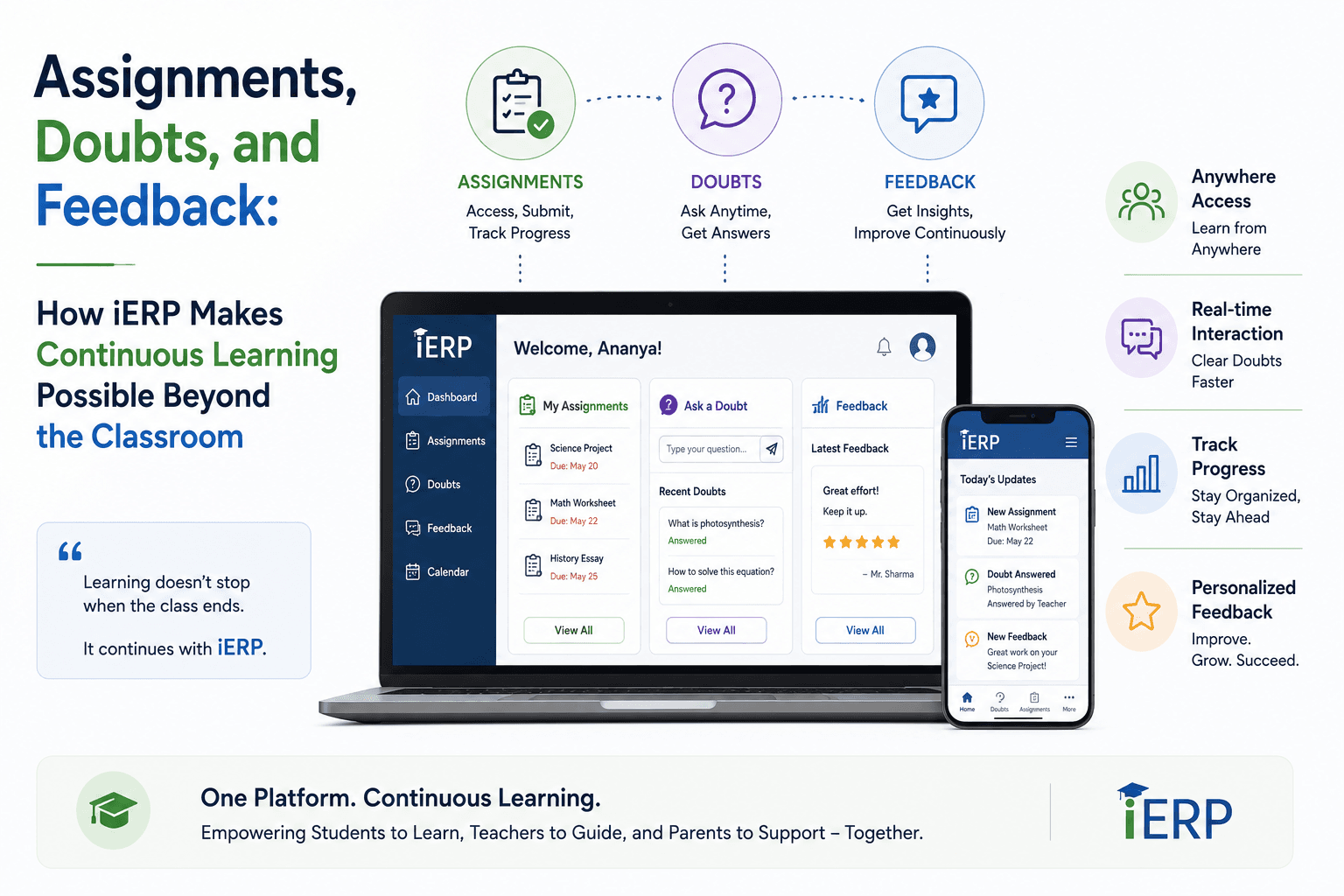
iERP is built on a different premise: that the school day should not be the boundary of what the school can offer. That assignments, doubts, and feedback - the three engines of continuous learning - should not stop working when the final bell rings.
Here is how that works in practice.
The school diary is one of the most reliable pieces of school infrastructure in Indian education. It also has a fundamental flaw: it depends entirely on the student.
The student who transcribes the assignment incorrectly. The student who leaves the diary in the bag on the day the parent needed to check it. The student who omits the note about additional reading materials because there wasn't space in the margin. The parent who checks the diary at 9 PM and finds three words that tell them nothing about what their child actually needs to do.
These are not hypothetical scenarios. They are the daily reality of homework management in most schools - and they have a real cost. Students who do not receive or understand an assignment clearly are not being lazy when they submit incomplete work. They are the downstream consequence of a communication system that was designed for a different era.
iERP replaces the physical diary as the channel for assignment communication - and in doing so, changes what an assignment can be.
When a teacher sets an assignment through iERP, the moment they submit it, it arrives on the parent's app and the student's device simultaneously. Not as a transcribed sentence in a diary, but as a complete brief: the task, the due date, any supporting materials, and any specific instructions the teacher wants to attach.
A parent who sees their child's mathematics assignment the same evening it was set - with the exact wording their child's teacher used, attached to any relevant worksheets - is a parent who can meaningfully support their child's homework rather than asking "what did the teacher say?" and receiving a shrug.
But what matters as much as the delivery is the confirmation. iERP allows teachers to see which parents have acknowledged the assignment - who has seen it and when. For the first time, a teacher knows not just that they set the homework, but that it reached the families it was intended to reach.
That accountability loop - assignment set, assignment received, completion expected - is what connects the classroom to the home in a way that the physical diary never could.
Here is something teachers know that curriculum planners sometimes forget: most genuine learning questions don't arise during the lesson.
They arise at 7 PM, when a student sits down to complete their assignment and hits a wall. They arise on Sunday afternoon, when a student reads ahead and encounters a concept that the chapter explains unclearly. They arise three days after the lesson, when a student is reviewing notes for a test and realises they wrote something down that doesn't quite make sense.
In most schools, a student with a genuine question at 7 PM on a Tuesday has two options: write it down and hope they remember to ask it by the following morning, or proceed with incomplete understanding and hope the gap doesn't matter.
Both options are worse than they need to be.
iERP creates a structured channel through which students can raise doubts outside classroom hours - and teachers can respond at a time that suits them, rather than being interrupted mid-lesson or at the school gate. The doubt reaches the teacher. The teacher responds when they are able to. The student receives the clarification before their next study session or their next class.
The asymmetry of this arrangement matters more than it might seem. A student who raises a doubt and receives a response before the next lesson arrives at that lesson ready to build on the concept, rather than still confused about what they didn't understand. The quality of what a teacher can do in the next class is directly affected by what students were able to clarify in between.
This is not about replacing face-to-face teaching. It is about filling the gap between teaching sessions with structured, purposeful communication that keeps learning continuous rather than episodic.
Of the three pillars of continuous learning, feedback is the one with the strongest evidence base and the most consistent implementation gap.
Research on learning is unambiguous: specific, timely feedback is one of the highest-impact interventions available to any teacher. A student who receives feedback that tells them not just what was wrong but why it was wrong, and what to do differently, learns significantly more from an assignment than one who receives a mark and no further commentary.
The problem is practical. A secondary school teacher with five sections and thirty-five students per section is managing over 170 student submissions per assignment cycle. The mathematics of meaningful individual feedback, at that scale, are daunting.
iERP reduces the friction in the feedback loop without reducing its quality. Teachers can deliver assignment feedback directly to individual students through the platform - specific, written, and attached to the assignment it addresses - without the logistical delay of returning physical work. Students receive feedback on their device, clearly attributed to the piece of work it relates to, without the confusion of trying to decipher margin notes or remember which red mark referred to which error.
For parents, the feedback loop closes a gap that has long existed in the school-home relationship. When a parent can see not just that an assignment was submitted but what feedback their child received on it, the parent meeting becomes a different kind of conversation. Not "how is my child doing?" but "I saw the teacher's note about the approach to essay structure - how are we working on that?"
That specificity - that ability to connect feedback to a particular piece of work and discuss it at home - is what makes continuous learning genuinely continuous. Not just within the school, but across the full environment in which a student actually lives and studies.
The phrase "beyond the classroom" is often used in education to describe extracurricular activities, sports, arts, and clubs. It is a worthwhile aspiration - but it points in a different direction from what most students most urgently need.
What most students most urgently need is not more activities beyond the classroom. It is for the academic work inside the classroom to be supported, clarified, and reinforced in the hours after the school day ends - when memory is consolidating, when confusion crystallises, when the homework sits on the table and the textbook doesn't quite explain what the teacher explained more clearly in the lesson.
Assignments that reach students clearly. Questions that can be asked and answered between sessions. Feedback that arrives while the work is still fresh and the learning is still active.
These are not ambitious innovations. They are basic conditions for learning that goes beyond the bell - that treats the school day not as the container of education but as the anchor around which continuous learning is organised.
iERP is built to create those conditions. Not to replicate the classroom in digital form, but to keep the school connected to the student at every point in the learning cycle - not just when the gates are open.