Join and be a part of
revolutionary education!
Contact us to get a demo of Vidh.
Download Our Mobile
App For Parents
Available on iOS and Android.


Contact us to get a demo of Vidh.
Available on iOS and Android.
Every student lives in two worlds. Most schools only see one of them.
There is a conversation that happens in some version in almost every Indian household, almost every evening.
A parent asks: "How was school today?"
A child says: "Fine."
And that is, for most families, the entirety of the daily information transfer between a child's two most important learning environments.
It is not that parents don't want to know more. It is not that children are being deliberately evasive. It is that the school and the home, in the way most educational systems are structured, are fundamentally separate worlds - each holding information the other needs, rarely sharing it in real time, and relying on a twelve-year-old as the primary bridge between them.
The consequences of this gap are not dramatic. They are quiet, cumulative, and consistently underestimated.
For the student, navigating two disconnected worlds is more cognitively demanding than it sounds. The child who is confused about a concept at school but cannot adequately explain the confusion at home sits with that gap. The child whose homework feels overwhelming but whose parent does not know enough about the assignment to help carries that weight alone. The child who received critical feedback from a teacher that would benefit from follow-up conversation at home never has that conversation - because the parent didn't know it happened.
For the parent, the gap produces a particular kind of anxiety that is hard to name and harder to act on. They know their child is at school for seven hours a day. They have limited visibility into what those seven hours contained. They receive a report card twice a year and a parent-teacher meeting perhaps once per term - brief, formal windows that compress seven hours a day, five days a week, into a twenty-minute conversation that both sides know cannot carry the weight it is being asked to carry.
Most parents want to be more involved in their child's learning. The barrier is not willingness - it is access. They do not know, on any given Tuesday, what was taught, what was assigned, what was understood, and what was struggled with. They cannot support what they cannot see.
For the teacher, the gap runs in the other direction. A teacher who does not know that a student's home situation changed three weeks ago, or that a child has been unwell for a week, or that family circumstances are making evening study impossible, is teaching with incomplete information about the person in the chair in front of them. The insight that would explain a student's behaviour, performance, or disengagement sits on the other side of the home-school gap - invisible unless a parent thinks to share it and has a clear channel through which to do so.
This is the structural reality that iERP is designed to change.
It is important to distinguish between what iERP creates and what most schools already have - or believe they have.
Most schools have communication channels. A WhatsApp group where notices go out. An SMS service for urgent announcements. A physical diary that travels between school and home. These are channels - one-directional, intermittent, and built primarily to transmit information from the school to the parent.
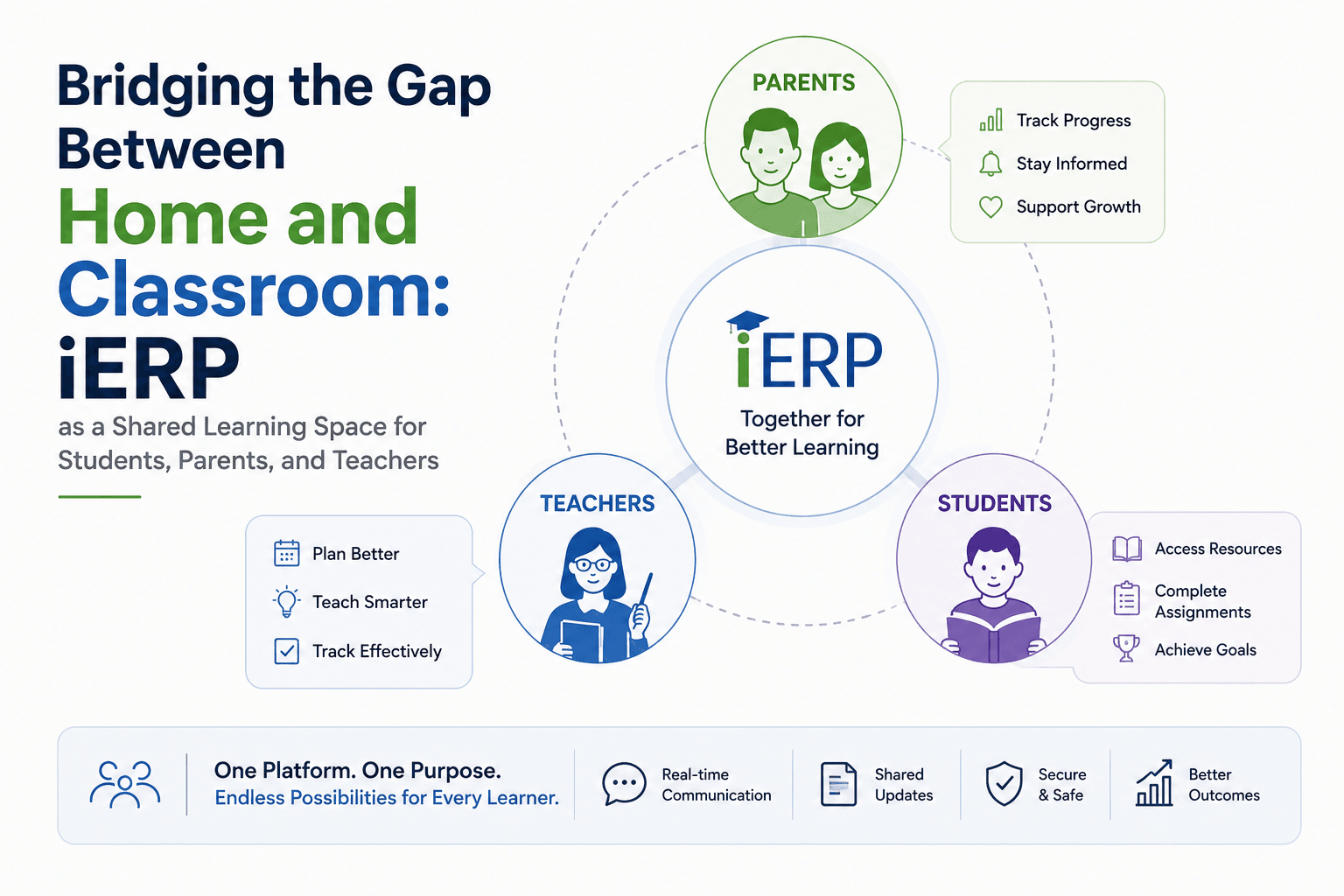
A shared learning space is something different. It is not a channel through which the school broadcasts - it is a common environment in which the student, the parent, and the teacher each have a view of the same information, at the same time, from their own perspective.
When a teacher sets an assignment in iERP, three things happen simultaneously: the student sees the assignment and what is expected of them, the parent sees what their child has been asked to do and when it is due, and the teacher retains visibility into whether the assignment reached both - and eventually, whether it was completed. One action. Three informed parties. No information lost in transcription.
When attendance is marked in the morning, a parent's phone carries the information before they have finished their commute. Not as a secondary notification hours later, but as part of the same moment - the attendance record and the parent notification are the same action, not separate steps.
When a teacher adds a feedback note to a student's submitted work, the student reads it on their device and the parent - if they choose - can see it in the same place. The feedback does not exist only in the teacher's memory or in margin notes on a physical paper that never leaves the school bag. It lives in a shared space that the parent can reference when they sit down with their child in the evening.
This is what it means to bridge the gap - not to give parents more messages, but to give them the same view.
There is a model in educational research sometimes called the learning triangle: student, teacher, and parent, each connected to the other two, each contributing to the learning environment in ways the other two cannot fully replicate.
The student brings lived experience, motivation, and the inner life of learning that only they can access.
The teacher brings subject expertise, pedagogical skill, and the observation of a child across thirty hours of structured learning every week.
The parent brings knowledge of the whole child - who they are at home, what worries them, what excites them, how they behave when they feel safe, and how they behave when they don't.
When all three sides of this triangle are connected - sharing information, responding to what they each observe, making decisions together - the learning environment a student inhabits is genuinely comprehensive. No significant information about a child's progress falls through the gap between the two institutions responsible for that child's development.
When any one side is disconnected - when parents are kept at a distance from the academic content, when teachers do not know what is happening at home, when students feel that the two worlds they live in have no relationship to each other - the triangle fails to function. Information is lost. Decisions are made without complete context. Problems that would be easy to address when shared between three parties become difficult to manage when carried by only one.
iERP is, at its most fundamental level, a tool for closing the triangle. For making the three-way connection that good educational outcomes require not a matter of fortunate circumstances or especially engaged families, but a matter of infrastructure that works the same way for every student in every section every day.
Schools that have implemented iERP consistently report the same early response from parents: not enthusiasm about features, but relief at visibility.
A parent who can check attendance, see the homework brief, and receive the teacher's note about last week's assessment in one place before 9 AM is not using more technology. They are spending less cognitive energy wondering, and more time engaging - with the information that is now available, and with the child who is now easier to support.
The parent who previously arrived at a parent-teacher meeting with a general sense of concern and a list of questions they'd been carrying for three months now arrives having seen the same performance data the teacher is looking at. The meeting is not a revelation - it is a continuation of a conversation that has already started, informed by the same information on both sides of the table.
This shift - from information asymmetry to shared visibility - is the practical meaning of a shared learning space. It does not require parents to engage with school systems they are unfamiliar with. It does not require teachers to do additional work to keep parents informed. It requires a platform that makes the information that already exists in the school available to the people outside the school who need it.
The gap between home and classroom is not primarily a physical problem. Schools and homes are often within a few kilometres of each other. The gap is an information gap - a structural absence of the shared context that makes it possible for students, parents, and teachers to work as a genuine team.
iERP does not replicate the classroom in a parent's home. It does not put a teacher in every household. What it does is give every member of the learning triangle access to the same ground truth - the same view of what was assigned, what was attended, what was assessed, and what feedback was given.
And when all three parties are standing on the same ground, looking at the same information, the conversations that follow - between parent and child, between teacher and student, between parent and teacher - become fundamentally more productive.
Not because any of these relationships changed. Because the information flowing through them finally did.