Join and be a part of
revolutionary education!
Contact us to get a demo of Vidh.
Download Our Mobile
App For Parents
Available on iOS and Android.


Contact us to get a demo of Vidh.
Available on iOS and Android.
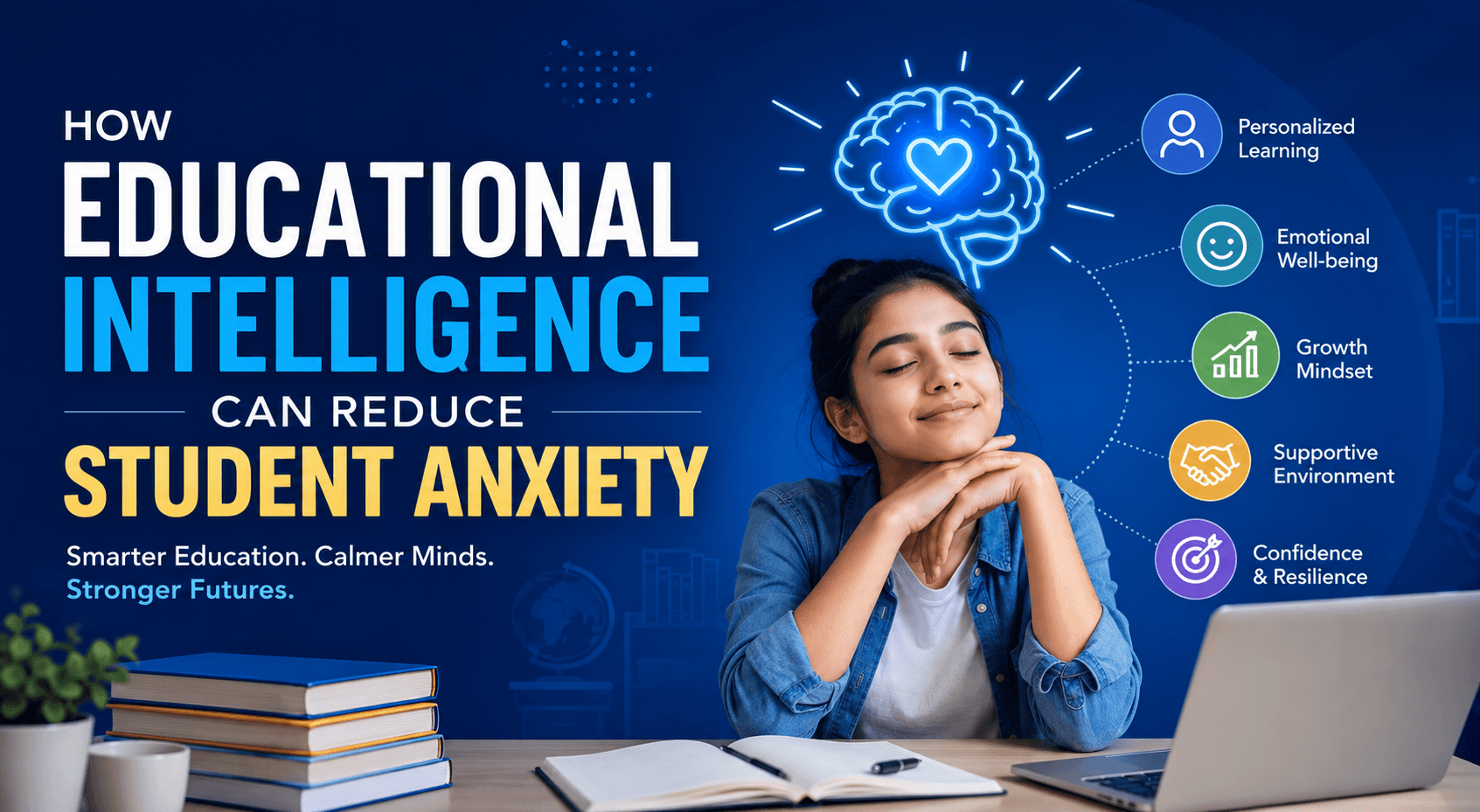
Educational Intelligence is a modern approach to learning that focuses on understanding how students learn, grow, adapt, and succeed beyond academic marks alone.
HOW EDUCATIONAL INTELLIGENCE CAN REDUCE STUDENT ANXIETY
Student anxiety has become one of the most pressing challenges in modern education. Today's learners face constant pressure from exams, grades, competition, parental expectations, social comparison, and uncertainty about the future. Many students grow up believing that academic marks alone determine their intelligence, success, and self-worth.
As a result, stress and anxiety are increasingly affecting students across all age groups. But what if education itself could become part of the solution rather than the source of the problem?
This is where Educational Intelligence plays a transformative role.
UNDERSTANDING THE ROOT CAUSES OF STUDENT ANXIETY
Student anxiety rarely develops overnight. It often emerges gradually due to factors such as:
• Fear of failure
• Excessive academic pressure
• Unrealistic expectations
• Comparison with peers
• Lack of emotional support
• Rigid learning systems
• Fear of judgment
• Uncertainty about future careers
In many traditional educational environments, students are rewarded primarily for outcomes rather than effort, growth, creativity, or understanding. This creates a culture where mistakes are feared instead of embraced as opportunities to learn. Over time, this pressure can affect confidence, motivation, emotional well-being, and even academic performance.
WHAT IS EDUCATIONAL INTELLIGENCE?
Educational Intelligence is a modern approach that focuses on how students learn, grow, adapt, and succeed beyond academic scores. It combines cognitive learning, emotional intelligence, personalized education, critical thinking, skill development, adaptive learning, and student well-being.
Rather than expecting every student to learn in the same way, Educational Intelligence recognizes that each learner is unique. This shift alone can significantly reduce stress and improve learning outcomes.
HOW EDUCATIONAL INTELLIGENCE REDUCES ANXIETY
1. Personalized Learning Reduces Pressure
Every student learns differently. Educational Intelligence promotes personalized learning experiences that allow students to learn at their own pace, focus on understanding instead of memorization, receive tailored support, and build confidence gradually.
When students are not constantly measured against others, anxiety naturally decreases.
2. Moving Beyond Marks Builds Healthier Mindsets
Many students tie their self-worth to exam scores. Educational Intelligence broadens the definition of success by recognizing creativity, communication skills, problem-solving ability, collaboration, innovation, and emotional growth.
When students are valued for their unique strengths, they become more motivated to learn rather than simply trying to avoid failure.
3. Early Identification of Stress Signals
Educational Intelligence helps educators identify early signs of stress and disengagement, including sudden drops in performance, reduced participation, lack of motivation, emotional withdrawal, and learning difficulties.
Early intervention allows teachers and parents to provide support before anxiety becomes a serious concern, creating a safer and healthier learning environment.
4. Stronger Teacher-Student Relationships
Students experience less anxiety when they feel understood and supported. Educational Intelligence encourages educators to focus on active listening, individual guidance, positive reinforcement, emotional awareness, and encouragement.
Supportive relationships help students feel comfortable asking questions, expressing concerns, and seeking help when needed.
5. Reducing the Fear of Failure
One of the greatest sources of anxiety is the fear of making mistakes. Educational Intelligence promotes a growth mindset where mistakes are viewed as part of the learning process.
This helps students take academic risks confidently, build resilience, improve self-esteem, and develop stronger problem-solving skills.
THE ROLE OF PARENTS AND TECHNOLOGY
Parents play a critical role in reducing anxiety by focusing on more than academic performance. Encouraging emotional well-being, curiosity, confidence, and personal growth can significantly improve a child's learning experience.
At the same time, modern educational technologies can support students through personalized learning paths, adaptive assessments, real-time feedback, and self-paced learning experiences that reduce unnecessary pressure.
THE FUTURE OF EDUCATION MUST PRIORITIZE WELL-BEING
Education should develop confident, capable individuals—not stressed learners who fear failure. The future of learning must balance academic excellence, emotional intelligence, mental well-being, creativity, adaptability, and human-centered learning.
Educational Intelligence provides the foundation for this balanced approach.
FINAL THOUGHTS
Student anxiety is not just an academic challenge—it is a human challenge. Solving it requires more than changing exams or reducing homework. It requires rethinking how education itself works.
Educational Intelligence creates learning environments where students feel supported, understood, and empowered. By shifting the focus from pressure-driven performance to meaningful growth, it helps students learn with confidence rather than fear.
Because when students learn without anxiety, they don't just perform better academically—they become healthier, happier, and better prepared for life.