Join and be a part of
revolutionary education!
Contact us to get a demo of Vidh.
Download Our Mobile
App For Parents
Available on iOS and Android.


Contact us to get a demo of Vidh.
Available on iOS and Android.
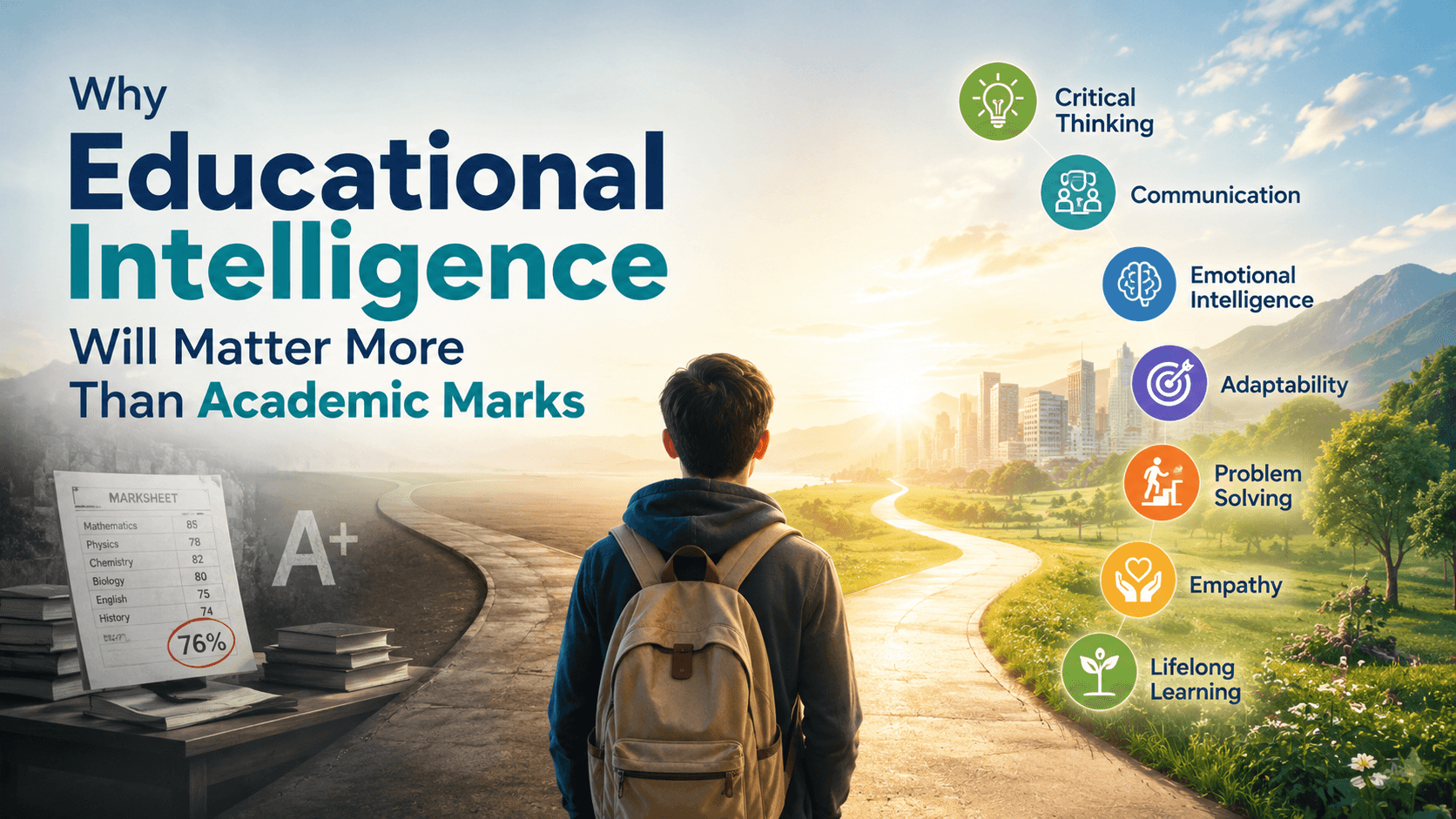
Educational intelligence is about preparing students for life — not just exams. It combines academic understanding with emotional, creative, digital, and practical intelligence. In today’s rapidly evolving world, this combination matters more than ever.
For decades, academic marks have been treated as the ultimate measure of a student’s success. A high score meant intelligence. A rank card determined future opportunities. Parents celebrated marksheets, schools showcased toppers, and students grew up believing that numbers defined their worth.
But the world has changed.
Today, employers, universities, entrepreneurs, and even society itself are beginning to value something much bigger than marks — Educational Intelligence.
Because in real life, success is not built only on memorization or exam performance. It is built on how well a person can think, adapt, communicate, solve problems, collaborate, and continue learning.
And that is exactly why educational intelligence will matter far more than academic marks in the years ahead.
Marks were originally designed to measure academic understanding within a limited system. While they can indicate discipline and subject knowledge, they often fail to measure a student’s actual capabilities.
A student may score 95% in exams but struggle to:
At the same time, another student with average marks may possess extraordinary creativity, leadership, emotional intelligence, or problem-solving ability.
Yet traditional systems rarely recognize these strengths.
This creates a dangerous gap between education and real-world readiness.
Educational Intelligence goes beyond textbooks and report cards.
It refers to a student’s ability to:
In simple terms, educational intelligence is about preparing students for life — not just exams.
It combines academic understanding with emotional, creative, digital, and practical intelligence.
And in today’s rapidly evolving world, this combination matters more than ever.
The modern world is driven by innovation, technology, and rapid change.
Industries are evolving faster than educational systems. Many future jobs do not even exist yet. Artificial Intelligence, automation, and digital transformation are reshaping how people work and learn.
In such a world, memorizing answers is no longer enough.
Students need the ability to:
These are not qualities measured by marksheets.
They are qualities built through educational intelligence.
Companies today are increasingly focusing on skills and adaptability rather than academic scores alone.
A degree may help someone get an interview.
But long-term success depends on:
Many global organizations now use skill assessments, project portfolios, internships, and real-world problem-solving tasks during hiring processes.
Why?
Because academic marks only show how well a student performed in an exam environment.
Educational intelligence shows how well a person can perform in life and work.
Every student learns differently.
Some understand visually. Some learn through experience. Some excel in creativity, while others shine in analytical thinking.
Traditional education often forces every student into the same evaluation model.
But modern learning platforms are changing that.
With personalized learning, students can:
This approach nurtures educational intelligence instead of creating unhealthy pressure around marks.
And this is where modern EdTech platforms are making a significant impact.
One of the biggest changes needed today is in mindset.
Parents often ask:
“What marks did you score?”
But perhaps the better questions are:
When children are valued only for marks, they may fear failure.
But when they are encouraged to learn, explore, and think independently, they develop confidence and lifelong intelligence.
Education systems can no longer focus only on syllabus completion and examinations.
Schools of the future must focus on:
Students should not graduate with just subject knowledge.
They should graduate with the ability to navigate life confidently.
Digital learning platforms, AI-powered education, immersive learning experiences, and adaptive assessment systems are transforming how students learn.
Technology can now identify:
This enables education to move from “one-size-fits-all” learning to intelligent learning experiences.
The future of education is not about producing toppers.
It is about producing capable, adaptable, and intelligent individuals.
Academic marks will always have some importance.
But they are no longer the ultimate definition of intelligence or success.
The future belongs to students who can think, adapt, create, communicate, and continuously learn.
Educational Intelligence is becoming the true measure of readiness for the modern world.
Because life does not reward those who only memorize answers.
It rewards those who can understand, innovate, and evolve.
And that is exactly why educational intelligence will matter far more than academic marks in the years ahead.