Join and be a part of
revolutionary education!
Contact us to get a demo of Vidh.
Download Our Mobile
App For Parents
Available on iOS and Android.


Contact us to get a demo of Vidh.
Available on iOS and Android.
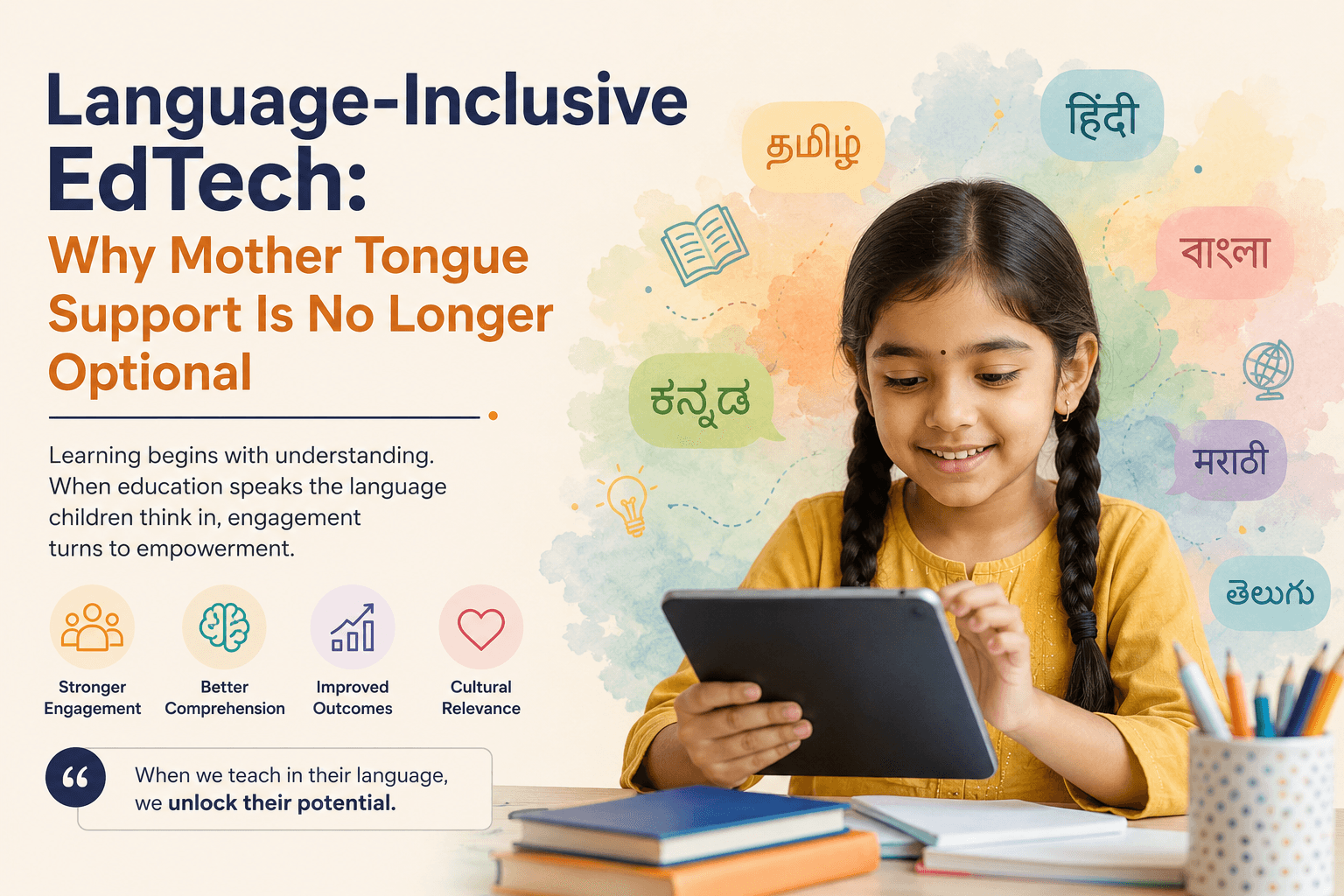
Most school management platforms are built in English, for English-speaking users. For schools serving diverse communities across India, this is a real problem — and a solvable one.
Language is not a feature. It is the medium through which software either works for people or does not.
A school management platform deployed in a school where teachers primarily communicate in Telugu, and parents primarily communicate in Hindi, that offers only an English interface, is not fully deployed. It is partially deployed — for the portion of the school community that is comfortable in English, and not for the rest.
In the Indian school context, this is not an edge case. It is the norm.
The Language Gap in Indian EdTech
India has over 20 officially recognized languages, hundreds of regional dialects, and a school system that serves communities whose primary language of daily life often differs significantly from the language of instruction in English-medium schools.
This creates a structural tension: English-medium schools teach in English, but their teachers, administrative staff, and parent communities may be far more comfortable — and far more effective — in a regional language.
Most EdTech platforms were designed for English-speaking markets and adapted for India without fully rethinking the language layer. The result is software that teachers use haltingly, administrative staff interpret roughly, and parents engage with minimally.
Where Language Support Matters Most
Teacher-Facing Tools
AI-assisted lesson plan and worksheet generation is only useful if it generates content in the language the teacher needs. A teacher creating materials for a CBSE school in Andhra Pradesh may need the framework in English but explanatory content in Telugu. A platform that supports only English AI generation is, for this teacher, partially useful at best.
Parent Communication
Parent notifications, fee alerts, and event communications need to reach parents in the language they actually read. An SMS or app notification that a parent has to struggle to understand defeats the purpose of sending it. Worse, critical communications — fee due notices, attendance alerts — may be ignored not because the parent does not care, but because the language barrier creates friction.
Administrative Interfaces
Staff members who are not highly proficient in English but are highly capable school administrators should not be disadvantaged by the language of their management software. Support staff, bus assistants, inventory managers, and attendance officers should be able to use the platform confidently in their primary language.
The Competitive Advantage for Schools
Schools that deploy language-inclusive platforms have a meaningful advantage in parent trust and community engagement. When parents receive communications in their preferred language and can interact with the school app comfortably, their engagement increases. School events are better attended. Fee payment reminders are more effective. Questions are raised and resolved faster.
For schools in Tier 2 and Tier 3 cities — where English proficiency in parent communities may be lower than in metropolitan areas — this advantage is substantial.
What "Language Support" Actually Means in Practice
Not all language support is equal. There is a meaningful difference between:
Schools evaluating platforms should ask which of these three levels the platform actually delivers, and for which specific languages.
They should also ask whether the language configuration is per-user or platform-wide. A school where some teachers prefer English and others prefer Telugu needs user-level language settings, not a single system-wide toggle.
The Path Forward
The Indian education sector is not moving toward uniformity — it is embracing its linguistic diversity as a feature of its educational identity. The EdTech platforms that will serve Indian schools well over the next decade are the ones that were built with this diversity as a design constraint from the beginning, not retrofitted as an afterthought.
For school leaders evaluating platforms today, language support should be on the evaluation checklist alongside security, fee management, and module coverage. It is not a nice-to-have. It is a basic requirement for a platform that actually works for everyone in your school community.
Vidh is a language-agnostic platform with native support for Telugu, Hindi, and other Indian languages - including AI-powered content generation in regional languages. Built for the actual diversity of Indian schools.