Join and be a part of
revolutionary education!
Contact us to get a demo of Vidh.
Download Our Mobile
App For Parents
Available on iOS and Android.


Contact us to get a demo of Vidh.
Available on iOS and Android.
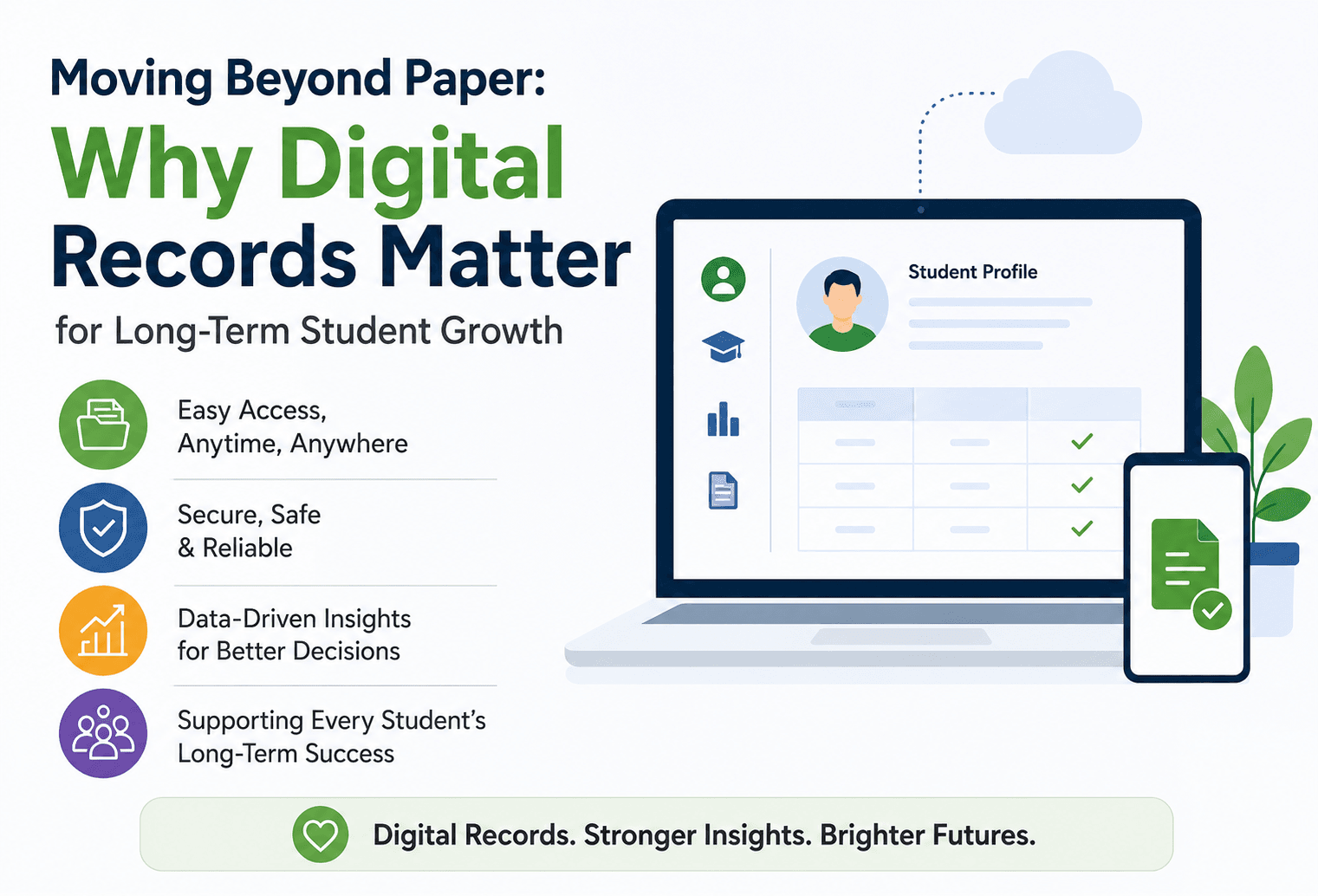
A report card tells you where a student is. A digital record tells you where they've been - and where they might be headed.
Somewhere in a school office, in a steel almirah that hasn't been fully opened since the last admission season, there are records of students who passed through this school five, eight, twelve years ago.
Register books. Progress cards. Attendance sheets. Handwritten term reports with observations that took a teacher forty minutes to write and have not been read since the day they were filed.
These are not useless documents. They represent genuine effort - teachers who cared enough to observe carefully, administrators who were meticulous enough to maintain records across decades. But they share a fundamental limitation that no amount of care can overcome: they are inert. They cannot be searched, compared, or analysed. They cannot tell you that a student who struggled in Class 5 English showed the same pattern in Class 3 - a pattern that, if someone had connected the two years, might have pointed to a reading difficulty that three years of remediation could have addressed.
The information was there. It just couldn't be used.
This is the central problem with paper-based student records - not that they don't exist, but that they exist in a form that makes them almost impossible to act on. And it is the reason why moving to digital records is not a technology decision. It is a decision about what kind of school you want to be - one that accumulates information, or one that uses it.
The report card is the most familiar form of student record in Indian schools. Produced at the end of each term, it captures a student's performance at a single point in time - a snapshot taken after fourteen or sixteen weeks of learning.
There is nothing wrong with snapshots. But a collection of snapshots is not the same as a story.
A student who scores 58% in Class 6 Mathematics is a very different situation from a student who scored 72% in Class 5, 65% in Class 5 term 2, and 58% in Class 6. The second student is on a trajectory. The first student is just a number with no context. The report card, by itself, cannot tell you which one you are looking at.
This is what educators mean when they talk about longitudinal records - records that capture not just where a student is but where they have been, and whether the direction of travel is cause for concern or cause for confidence. A student who has been steadily improving from 45% to 62% over three terms needs a different response from their teacher than a student who has declined from 78% to 62% over the same period. The current number is identical. The meaning is completely different.
Paper records, maintained in different formats by different teachers across different years, cannot produce this longitudinal view. Digital records, maintained in a consistent system from the day a student is enrolled, can.
There is a moment in every school year that represents one of the highest-risk points for student continuity - the transition between academic years.
In June or July, a new teacher receives a class. In most schools, what they receive along with the class register is: a seating arrangement, a timetable, and whatever they happen to know personally about the students from conversations in the staffroom. The detailed academic history of each child in that room - what they understood, what they struggled with, where they made progress, what specific feedback their previous teacher gave them - is in a file in the previous teacher's desk, or in a register that has been handed to the academic coordinator, or in the memory of a colleague who is now responsible for a different group of children.
The new teacher starts, effectively, from zero. They spend the first four to six weeks of the academic year diagnosing what the class already knows - work that the previous teacher's records could have completed in a fraction of the time, if those records were accessible and usable.
Digital records eliminate this problem. When a student's academic history, attendance patterns, teacher observations, and previous year's performance are available to the next year's teacher before the first day of class, that teacher can walk into the classroom already knowing which students need additional support, which are ready to be stretched, and which showed a pattern last year that deserves monitoring this year.
This is not a small efficiency gain. In a school year of thirty-six weeks, the difference between a teacher who starts informed and one who starts from scratch represents several weeks of better-calibrated instruction for every student in the class.
Consider a student - call her Ananya - who is in Class 7. Her current mathematics performance is average, her attendance is reasonable, and she has not come to her teacher's attention as a student who needs specific support. On any given day, she is one of thirty-five students in the room, presenting no urgent signal.
Her digital record, however, tells a more specific story. Her mathematics scores have declined by an average of eight percentage points per term for the past three terms. Her attendance in mathematics periods specifically is four percentage points lower than her overall attendance rate. The homework completion data shows that she submitted all mathematics assignments in Class 5, began submitting them late in Class 6, and has not submitted three in the current term.
None of these signals is individually alarming. Together, they describe a student who is losing confidence in a subject, increasingly avoiding the moments of exposure that feel most threatening, and beginning to develop the belief - quietly and without announcing it to anyone - that she is not a mathematics person.
A teacher looking at Ananya's current performance data would not see this. A teacher looking at Ananya's longitudinal digital record would.
The intervention that is appropriate for Ananya right now - a conversation about what specifically feels difficult, an adjusted approach to how mathematics is presented, a closer watch on her confidence rather than just her marks - is only available to a teacher who can see the pattern. Paper records cannot show it. A digital system that has been capturing consistent data across three years of her schooling can.
This is what it means for records to support long-term student growth - not just to document outcomes, but to make patterns visible while there is still time to change them.
For parents, digital records change the parent-teacher meeting in a specific and valuable way. Instead of a conversation that begins with "let me tell you how your child is doing this term," it becomes a conversation that can begin with "let me show you how your child has grown over the last three years."
The difference is not merely rhetorical. A parent who can see their child's academic trajectory - not as a series of disconnected report cards but as a continuous record of progress - has a fundamentally different relationship with the information being presented. They can see whether the current performance represents an improvement on last year. They can see whether the areas of difficulty have remained consistent over time, suggesting something structural, or whether they are new, suggesting something situational. They can see what their child has achieved, not just where they currently stand.
This longitudinal view also changes how parents respond to setbacks. A single difficult term is alarming in isolation and contextual within a positive trend. A parent who can see both the setback and the context is better positioned to respond proportionately - to support rather than panic, to understand rather than simply react.
The case for digital student records is sometimes made in terms of efficiency - faster retrieval, less physical storage, reduced administrative burden. These benefits are real. But they are secondary to the more important argument.
Digital records matter for long-term student growth because growth, by definition, happens over time. It cannot be seen in a single assessment or a single term. It emerges from the pattern of many data points, connected across weeks and months and years, interpreted by people who know the student and are willing to act on what the data shows.
Paper records accumulate. Digital records connect.
And it is in the connections - between Class 5 and Class 6, between attendance and performance, between one teacher's observation and the next teacher's first day - that the students who would otherwise fall through the gaps have the best chance of being caught.
The school that keeps consistent digital records of every student's learning journey is not simply a more efficient school. It is a school that has committed to knowing its students over time - not just at the moment of assessment, but across the full arc of their growth.
That commitment is not made by buying a system. It is made by using one well, consistently, year after year.
And the students who benefit are the ones who most need someone to be paying attention to over the long term - the quiet decliners, the late bloomers, the students whose patterns only become visible when the full picture is available.
Digital records make that picture possible.