Join and be a part of
revolutionary education!
Contact us to get a demo of Vidh.
Download Our Mobile
App For Parents
Available on iOS and Android.


Contact us to get a demo of Vidh.
Available on iOS and Android.
Most schools review their performance once a term. By then, the problems worth fixing have already compounded into the problems worth dreading.
There is a particular kind of surprise that school leaders know well.
The surprise of a term-end result that reveals a student was struggling for months before anyone noticed. The surprise of a fee collection shortfall that turns out to have been building since Week 3. The surprise of three admission inquiries that went unanswered for two weeks because no one was tracking them.
These surprises share a common origin. Not negligence — most school leaders are among the most conscientious professionals in any room. The origin is something more structural: most schools review their health monthly, or termly, or when something goes visibly wrong. By that time, what could have been a small correction has become a significant problem.
Weekly tracking changes this. Not because it adds more work — done well, it actually reduces the reactive firefighting that consumes disproportionate time. But because a problem identified in Week 2 looks completely different from the same problem identified in Week 8.
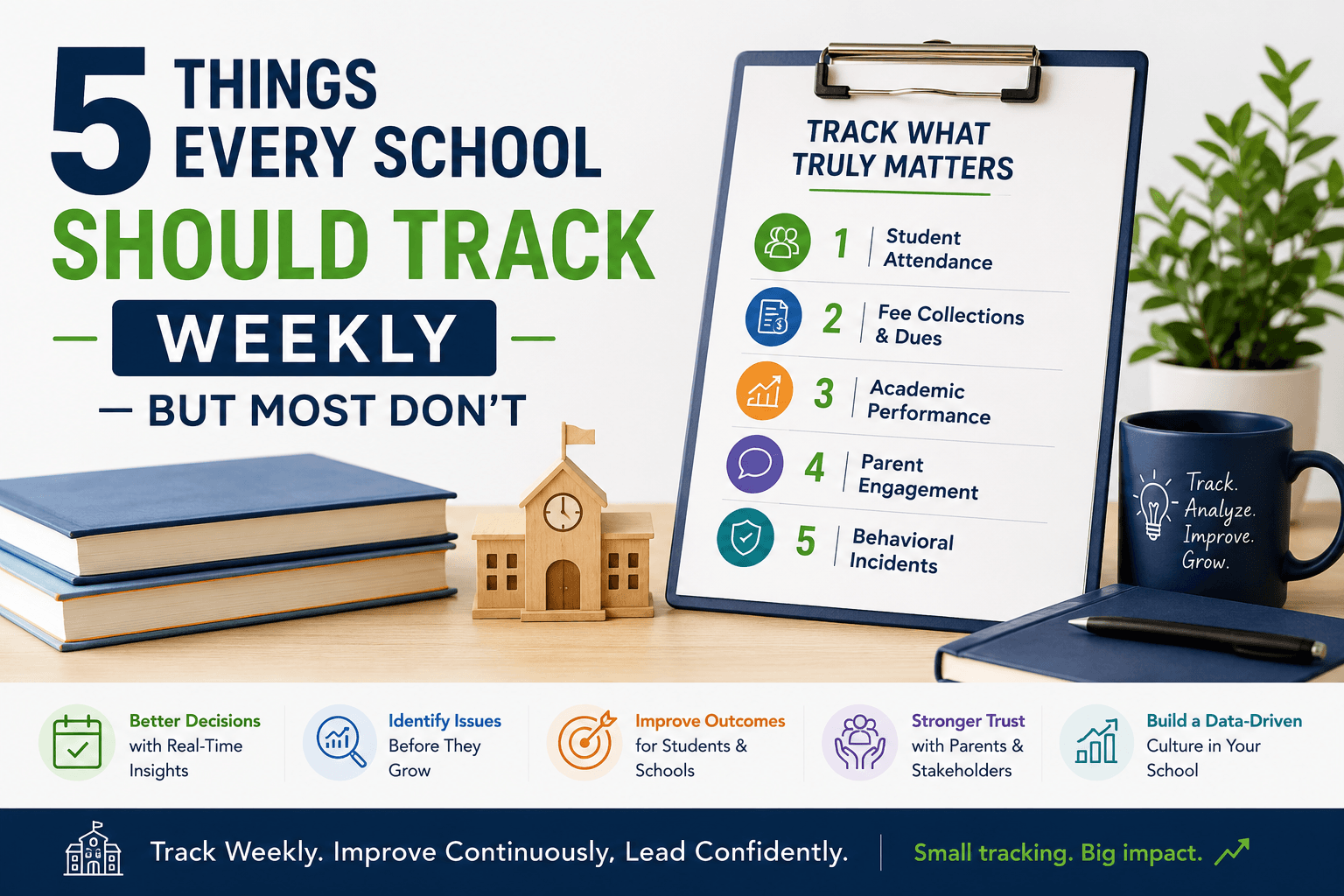
Here are the five things every school should be reviewing each week — and what to do when the numbers tell you something is off.
Most schools track daily attendance. Far fewer track attendance trends.
There is a meaningful difference between knowing that 47 students were absent on Tuesday and knowing that Section 8B has had an average of 12% absenteeism every Monday for the past four weeks. The first is a data point. The second is a pattern — and patterns have causes worth investigating.
What to track weekly:
What the data often reveals:
A Monday absenteeism spike in a specific section might indicate a teacher whose class is avoided. Persistent absenteeism in the same three or four students, week over week, might indicate a family difficulty that no one has yet connected to the school. A school-wide dip in attendance that corresponds to a specific period in the timetable is worth investigating.
Attendance data, reviewed weekly, is not just an administrative record. It is an early warning system for student welfare, teacher dynamics, and school culture — if someone is actually reading it.
Ask most school administrators how much is currently outstanding in fees and you will usually get a number that is two to three weeks old. Ask them which families are carrying arrears from the previous term and you may get a longer pause.
Fee arrears in schools are not primarily a financial problem. They are a communication and tracking problem. Most families who fall behind on fees are not unwilling to pay — they are disorganised, unreminded, uncertain about the amount, or dealing with a temporary difficulty they would address if someone reached out.
Weekly fee tracking makes the difference between a problem caught in Week 2 and a problem that becomes an awkward conversation in Week 10.
What to track weekly:
What weekly visibility enables:
When the accountant can see on Monday morning that 23 families missed the Friday deadline, the follow-up that week is timely, personal, and often resolves the situation quickly. When the same information surfaces at month-end, it requires three weeks of catching up — calls, messages, manual follow-up — that consumes far more time and goodwill.
The principle is simple: fee arrears addressed in Week 1 are a reminder. Fee arrears addressed in Week 6 are a conversation about trust.
This is the tracking metric most schools have never thought of — and one of the most revealing.
Every week, count the number of parent queries your administrative office receives about basic information: attendance records, homework details, upcoming events, fee receipts, school notices. Not complex issues — basic information that, in a well-functioning school, parents should be able to access themselves.
The number tells you something direct: how well your current communication system is actually serving parents.
A school receiving 40 queries a week about whether homework was assigned is a school with a homework communication problem. A school receiving 25 calls about fee receipts is a school whose payment confirmation process needs work. A school whose query volume drops from 60 to 15 over two terms has genuinely improved its parent communication — and that improvement shows up in parent satisfaction before any survey confirms it.
What to track weekly:
The trend matters more than the number. If query volume is declining over time, your communication infrastructure is improving. If it's flat or rising despite a new platform or process, something in the chain isn't working the way you think it is.
An admission inquiry has a lifespan. A family that submits an inquiry today and hears nothing for four days is a family that has probably continued their search. By the time your team calls them back at the end of the week, they are significantly less interested than they were on Monday.
This is not an exaggeration. Schools that have implemented structured admissions tracking consistently find that response-time is one of the highest-impact variables in inquiry-to-enrollment conversion — more than fee structure, more than academic reputation, and often more than proximity.
Weekly admissions pipeline tracking forces accountability into a process that is almost always managed informally.
What to track weekly:
What to do with the information:
Any inquiry older than 48 hours without a first contact should trigger a same-day follow-up. Any inquiry that has been "pending visit" for more than two weeks with no movement needs a personal call. The weekly review is not a report-reading exercise — it is a prompt for specific action on specific inquiries that are at risk of going cold.
An admissions pipeline without weekly review is not a pipeline. It is a list.
5. Academic Flags — The Early Warning System Most Schools Activate Too Late
This is the hardest metric to track — and arguably the most important.
Most schools identify students who are academically struggling at the term-end result. By then, the student has spent 10 to 14 weeks in difficulty, and what could have been addressed with a conversation and a support plan in Week 4 now requires a significant remediation effort in a compressed timeline.
Weekly academic flagging is the practice of reviewing which students are showing early indicators of difficulty — not just in marks, but in the patterns that precede declining marks.
What to flag weekly:
The key principle:
Academic flags are not failure notifications — they are prompts for early conversation. A form teacher who knows in Week 5 that a student's assignment completion has dropped to 40% can have a quick, low-stakes check-in conversation. A form teacher who finds out at Week 12's term results that the student has failed two subjects has missed the window where intervention is easy.
The schools that consistently produce stronger academic outcomes are not the ones with the most talented teachers or the most rigorous curriculum. They are the ones that know which students need attention while there is still time to give it.
Making the Weekly Review Work
Five metrics, one weekly review. In practice, this should take no more than 30 to 45 minutes for a school of any size — if the data is already being collected and is accessible in a consolidated view.
The constraint is not time. It is data architecture. A school where attendance is in a spreadsheet, fees are in a ledger, queries are in the administrator's memory, admissions are in a WhatsApp chat, and academic data is in individual teacher notebooks cannot do a weekly review in 45 minutes — because assembling the picture takes longer than reading it.
This is why the value of integrated school management systems is not primarily in the features they offer. It is in the access they provide — to information that already exists in the school, but currently lives in fourteen different places that nobody has time to consolidate every week.
When the data is together, the review is quick. When it's quick, it actually happens. And when it actually happens every week — not just when something goes wrong — the surprises stop.
That is the school that isn't reacting to problems. That is the school that is running.