Join and be a part of
revolutionary education!
Contact us to get a demo of Vidh.
Download Our Mobile
App For Parents
Available on iOS and Android.


Contact us to get a demo of Vidh.
Available on iOS and Android.
AI can build the scaffold. Only a teacher knows what needs to go inside it.
Sunday evening. 9:30 PM.
A Class 7 English teacher in Hyderabad sits at her kitchen table with a cup of tea, three textbooks, a curriculum calendar, and the quiet knowledge that Monday's lesson on subordinate clauses needs to be ready before she sleeps.
This is not unusual. A survey of teachers across Indian schools consistently shows that lesson preparation happens in the hours most people use for rest - evenings, weekends, and the forty minutes before the first bell. Not because teachers are inefficient. Because there are only so many hours in a school day, and the ones inside the classroom leave almost no room for the thinking that makes those hours valuable.
A well-prepared lesson is not a small thing. It involves understanding what the class knows already, anticipating where they will get confused, choosing the right sequence of explanation, finding or creating examples that will land, writing assessment questions that test the right thing at the right level of difficulty, and designing a closing activity that consolidates rather than just reviews.
This is the work that happens at 9:30 PM on Sunday. And it is the work that AI is beginning to change - not by replacing the teacher's judgment, but by removing the blank page.
Before considering what AI changes, it is worth being honest about what lesson planning currently costs.
A secondary school teacher in India typically manages five to seven subjects or sections per week. Each lesson requires preparation - some minimal, for familiar content, and some significant, for new topics or challenging classes. Averaged across the week, most teachers spend between eight and fifteen hours preparing lessons outside of teaching time.
That is a second working day, done largely invisibly, for which no additional compensation exists and which receives very little institutional acknowledgement.
The problem is not just the hours - it is what those hours displace. A teacher who spends Sunday evening writing a lesson plan from scratch is a teacher who is not resting. A teacher who is not resting is, by Monday afternoon, running on a reserve that has been drawing down since the start of term. By Week 10 of a fourteen-week term, the lesson plan quality and the teacher's energy are often invisible decline together.
This is the upstream cause of a great deal of what schools call teacher performance problems. The solution the system usually reaches for is more training. The solution worth considering is less unnecessary labour.
When AI lesson planning tools first appeared in education circles, the reaction was often binary - either enthusiasm that bordered on magical thinking, or dismissal rooted in the reasonable concern that no algorithm could replicate what a great teacher brings to a classroom.
Both responses missed what the tools actually do.
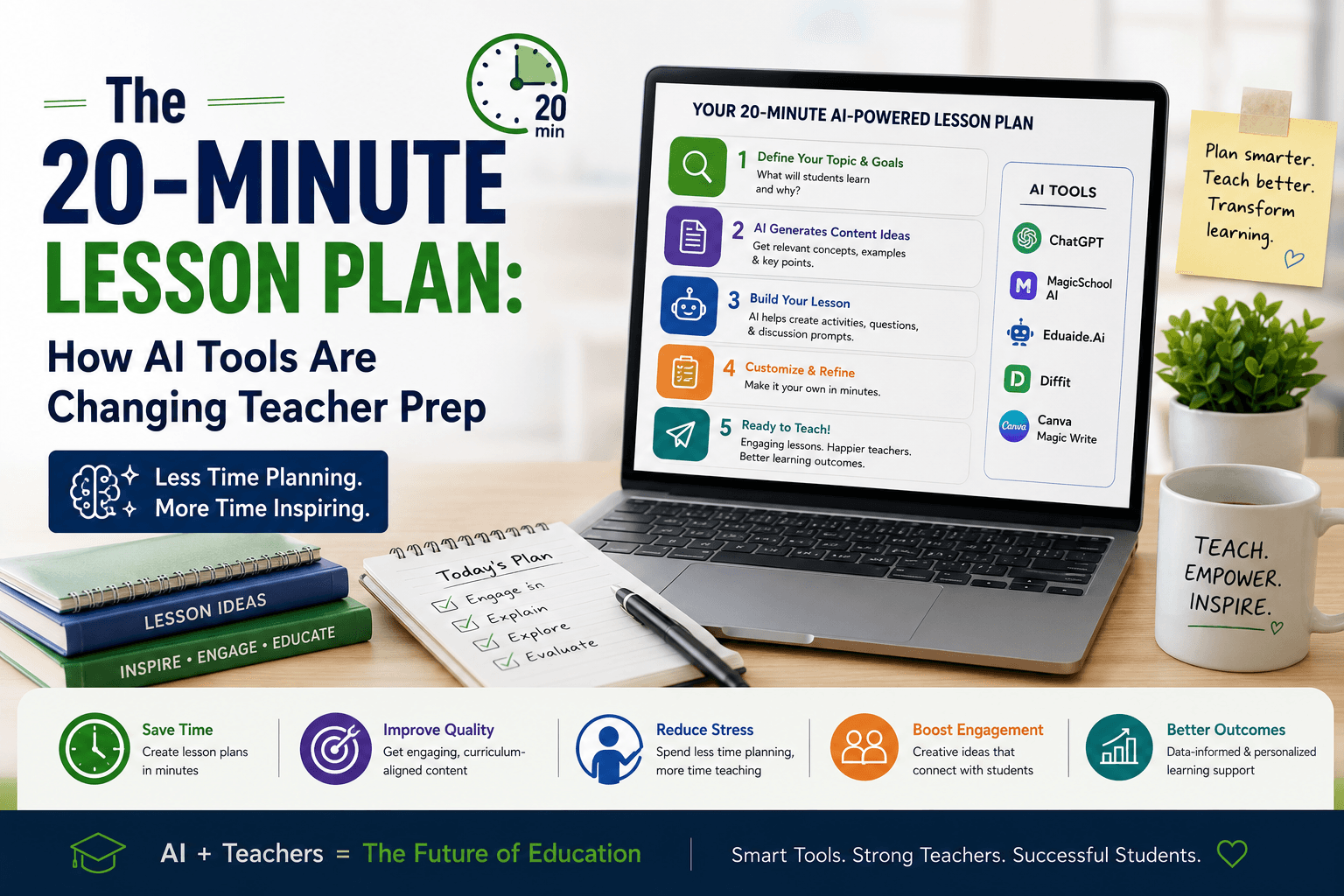
AI lesson planning tools - when built specifically for education rather than repurposed from general writing assistants - do something quite specific. They generate a structural scaffold for a lesson based on inputs the teacher provides: the topic, the class level, the curriculum board, the learning objective, the available time, and sometimes the specific areas of prior difficulty the class has shown.
What comes out is a draft. A sequenced, coherent draft that includes a learning objective, a lesson opening that connects to prior knowledge, a main instruction segment, student activity suggestions, and an exit assessment.
It is not a brilliant lesson. It is a usable starting point.
And a usable starting point, it turns out, is worth considerably more than it sounds.
Teachers who have used AI lesson tools consistently describe the same experience. The tool does not write their lesson for them. It eliminates the blank page - the hardest and most demoralising part of the preparation process.
The cognitive labour of beginning from nothing is disproportionate to the actual work involved. The thirty minutes a teacher spends staring at an empty document trying to work out how to open a lesson on the water cycle is not thirty minutes of productive thinking. It is thirty minutes of activation - of warming up, organising the subject knowledge, deciding on a structure. AI tools do this activation almost instantly.
What the teacher then does with the draft is where the value lives.
They look at the suggested opening and realise it doesn't account for the fact that this particular class missed last Friday's lesson on evaporation. They change it. They look at the suggested activity and know, with the specificity that only a classroom teacher has, that Section 8B will turn a group task into a social occasion if they're not given a concrete individual outcome. They restructure it. They read the suggested assessment question and see that it tests recall when this class actually needs to be pushed toward application. They rewrite it.
Twenty minutes of editing, informed by knowledge the AI does not have and cannot have, produces a lesson that is both structurally sound and genuinely calibrated to the specific humans in the room.
This is what "AI handles the structure, the teacher handles the insight" actually means in practice.
There is a genuine and important divide between what AI can produce and what a teacher brings. It is worth making this explicit, because the schools and teachers who get the most value from AI tools are the ones who understand it - and the ones who struggle are usually the ones who expect too much from the tool or too little from themselves.
AI knows the subject. A well-trained educational AI has access to vast amounts of pedagogical material, curriculum content, and structured teaching frameworks. It can produce a coherent explanation of photosynthesis or a sequenced introduction to fractions that is educationally sound.
AI does not know the class. It does not know that Priya in the second row has been struggling since the unit on respiration and will need a different scaffold than the rest of the class. It does not know that the class had a difficult assembly period and will need a settling activity before they can concentrate. It does not know that three students were absent last week and have a gap in their understanding that this lesson will accidentally assume is filled.
AI does not know the moment. The teacher who walks into a classroom and reads the room in the first sixty seconds - who adjusts the opening, slows down or speeds up, shifts from written to oral based on what they observe - is doing something that no AI currently participates in.
This is not a limitation to apologise for. It is the division of labour that makes human-AI collaboration in education genuinely productive. AI does the scaffolding. The teacher does the teaching.
When a teacher's lesson preparation shifts from ninety minutes to twenty minutes - not through reduced quality, but through a better starting point - several things become possible.
More differentiation, not less. A teacher with twenty minutes to refine a lesson can spend ten of those minutes creating a variation for students who need more support, something a two-hour exhausted session rarely produces.
Better assessments. Lesson preparation time is often consumed by the main content, leaving exit assessments rushed or neglected. When the structure arrives ready-made, assessment design gets actual thought.
More rest. This is not a productivity argument. A teacher who is adequately rested teaches better - attends to the students in the room more fully, responds to unexpected questions with more patience, sustains their energy through a full day. The downstream effect of better teacher preparation time is better classroom presence.
Reduced attrition. Schools that have implemented AI-assisted preparation tools as part of a broader workload management effort report measurable reductions in teacher dissatisfaction linked to working hours. Teachers do not leave schools because of difficult students. They leave because the work, structured the way it is currently structured, is unsustainable.
The adoption of AI lesson planning tools in a school is not primarily a technology decision. It is a culture decision.
A school that introduces AI tools while maintaining an implicit expectation that lesson preparation takes as long as it always has - that a two-page lesson plan submitted to the coordinator demonstrates commitment - will not get the benefit. Teachers will use the tools, produce better starting points faster, and then spend the remaining time producing documentation that satisfies an expectation rather than improving an outcome.
The schools that get the most from AI in lesson preparation are the ones that explicitly acknowledge what the tools are for: recovering teacher time and redirecting it toward the professional work that requires human judgment. The conversation to have is not "here is a new tool" but "we want our teachers spending more time on teaching and less time on administrative preparation - here is one way we are going to make that possible."
That framing changes the adoption dynamic entirely. And it is, incidentally, a much more honest description of what the technology actually does.
The teacher in Hyderabad who spent Sunday evening preparing her Class 7 lesson on subordinate clauses - she still has to walk into that classroom on Monday morning and teach it. She still has to notice who understands and who doesn't, decide in the moment whether to move on or stay, call on the student in the back who has been quiet for three days, and make the subject interesting enough that thirty twelve-year-olds remain willing to engage with it.
AI does not do any of that. AI never will.
What it can do is make sure that when she sits down on Sunday evening, the blank page is not her problem. The lesson is already sketched. The structure is already there. What she brings - the knowledge of her class, her professional judgment, her understanding of what this particular group needs on this particular day - is what turns a scaffold into a lesson worth remembering.
That is not a small thing. That is the whole thing.
And she should not have to do it at 9:30 PM.