Join and be a part of
revolutionary education!
Contact us to get a demo of Vidh.
Download Our Mobile
App For Parents
Available on iOS and Android.


Contact us to get a demo of Vidh.
Available on iOS and Android.
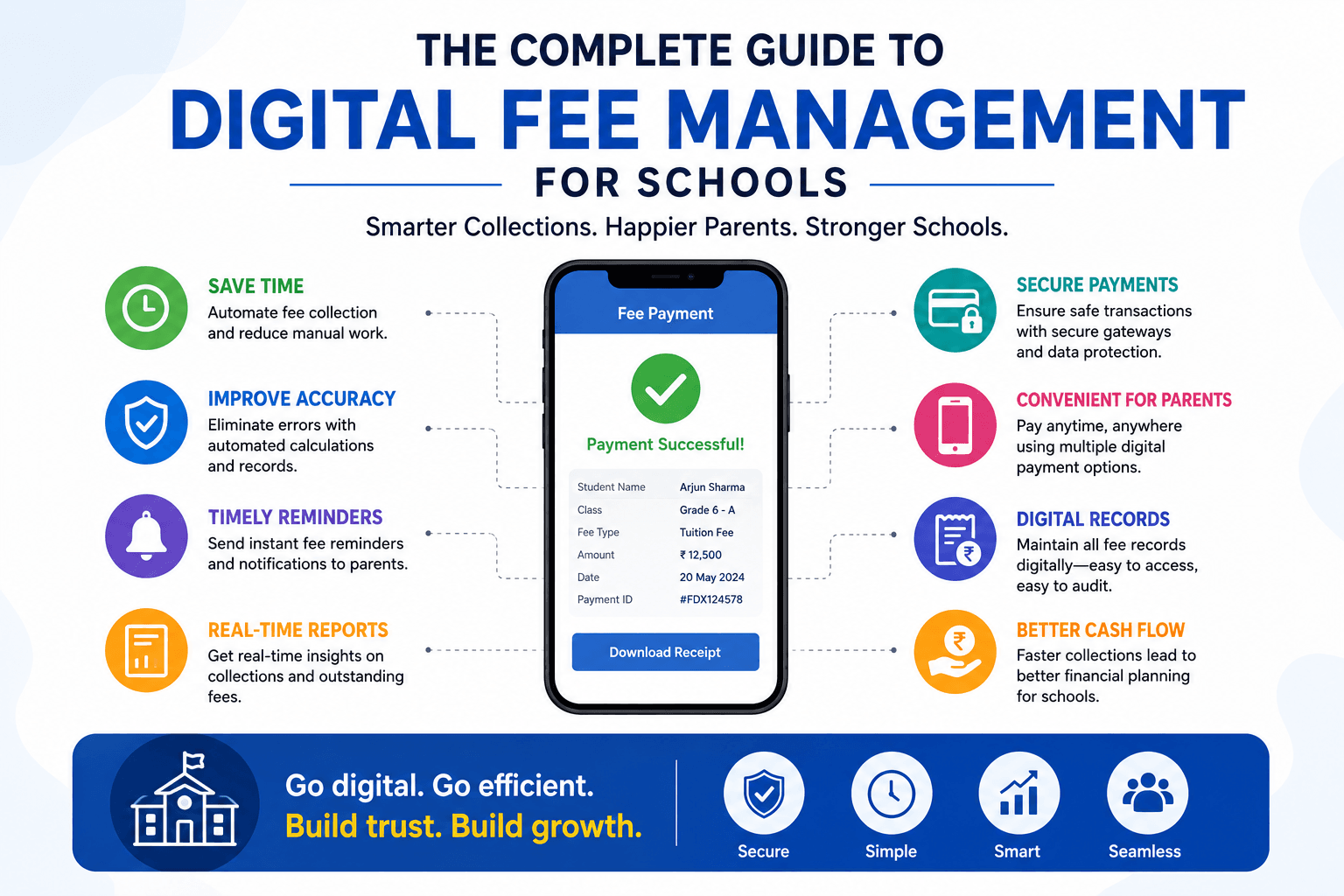
Manual fee collection is one of the biggest operational drains in school administration. Here's how digital fee management actually works - and what schools should look for.
School fee management is, on paper, a straightforward operation: collect money, record it, follow up on dues. In practice, it is one of the most time-consuming, error-prone, and dispute-generating processes in any school's administrative cycle.
Cash payments with handwritten receipts. Concession approvals that require three people in the same room. Custom fee structures for different classes, different categories of students, different term dates. Dues that exist in a ledger that only one accountant can read. If any of this sounds familiar, the problem is not the people — it is the process.
Why School Fee Management Is Uniquely Complex
Fee management in a school is not like billing in most businesses. A single school may have:
1. Multiple fee categories: tuition, transport, lab fees, library fees, uniforms, events
2. Different fee structures for different classes, or even different students within a class
3. Concessions granted by the principal for specific students
4. Payment plans that allow installment-based collection
5. Different rules for what appears on the parent app versus the admin dashboard
6. Historical dues migrated from previous academic years or from students transferring from other schools
Each of these variables multiplies the complexity. A school with 500 students and five fee categories across 15 classes is managing thousands of individual data points — and any error in the fee structure cascades into disputes, manual reconciliation, and loss of trust from parents.
How Digital Fee Management Solves Each Layer
Structured Fee Configuration
A proper digital fee system allows schools to define "fee heads" — categories of charges — and configure them as class-wise (applicable to a specific class), general (school-wide), or individual (custom for a specific student). This structure means the system enforces consistency automatically. No more manually checking whether a particular student should or should not receive a transport fee.
Concession Management
Concessions are one of the most sensitive areas of school finance. In a digital system, concession authority is typically restricted to the principal — meaning the system enforces the organizational hierarchy without requiring manual oversight of every transaction. Principals can apply either payment-level concessions (reducing a specific payment) or structural transitions (adjusting the student's fee category altogether).
Online Payment Integration
Direct online payment integrations allow parents to pay fees from their phone at any time — without visiting the school office, without cash, and without the administrative overhead of processing and recording physical payments. The system generates receipts automatically, updates the student's fee record in real time, and reduces the cashier's workload to exception handling rather than routine processing.
Automated Fee Reminders
Fee alerts — automated reminders sent to parents whose payments are overdue — eliminate the awkward and time-consuming process of calling parents individually about unpaid fees. The system sends reminders on schedule, tracks whether they've been acknowledged, and escalates according to configurable rules. This alone recovers significant staff time every month.
Expense Management
School finance is not only about income. A complete fee management system also handles school expenses — creating expense categories (maintenance, furniture, lab supplies, events), tracking individual line items against budgets, and giving the administration real-time visibility into spending. This closes the loop from revenue to expenditure in a single system.
Historical Data Migration
One of the most common objections to switching fee management systems is the fear of losing historical records. Schools that have been operating for several years may have years of fee histories in spreadsheets or legacy software. A well-designed platform handles bulk data imports via templates, allowing schools to migrate student records and previous dues without manual re-entry.
What Schools Should Look For When Evaluating Fee Platforms
Before committing to any fee management system, ask:
1. Can I configure fees by class, by student, and by fee category independently?
2. Who has authority to apply concessions — and is that enforced by the system?
3. Does online payment settlement go directly to the school's account?
4. What are the transaction fees, and how are they handled?
5. Can parents see their full payment history without calling the office?
6. Does the system support data migration from our existing records?
7. Are audit logs available to track who changed what, and when?
Fee management is where schools lose the most time and generate the most friction with parents. Getting this right is not a luxury — it is a foundational operational decision.
Vidh's fee management module supports class-wise, general, and individual fee configurations, principal-controlled concessions, direct payment integrations, automated alerts, expense tracking, and full bulk data migration from legacy systems.