Join and be a part of
revolutionary education!
Contact us to get a demo of Vidh.
Download Our Mobile
App For Parents
Available on iOS and Android.


Contact us to get a demo of Vidh.
Available on iOS and Android.
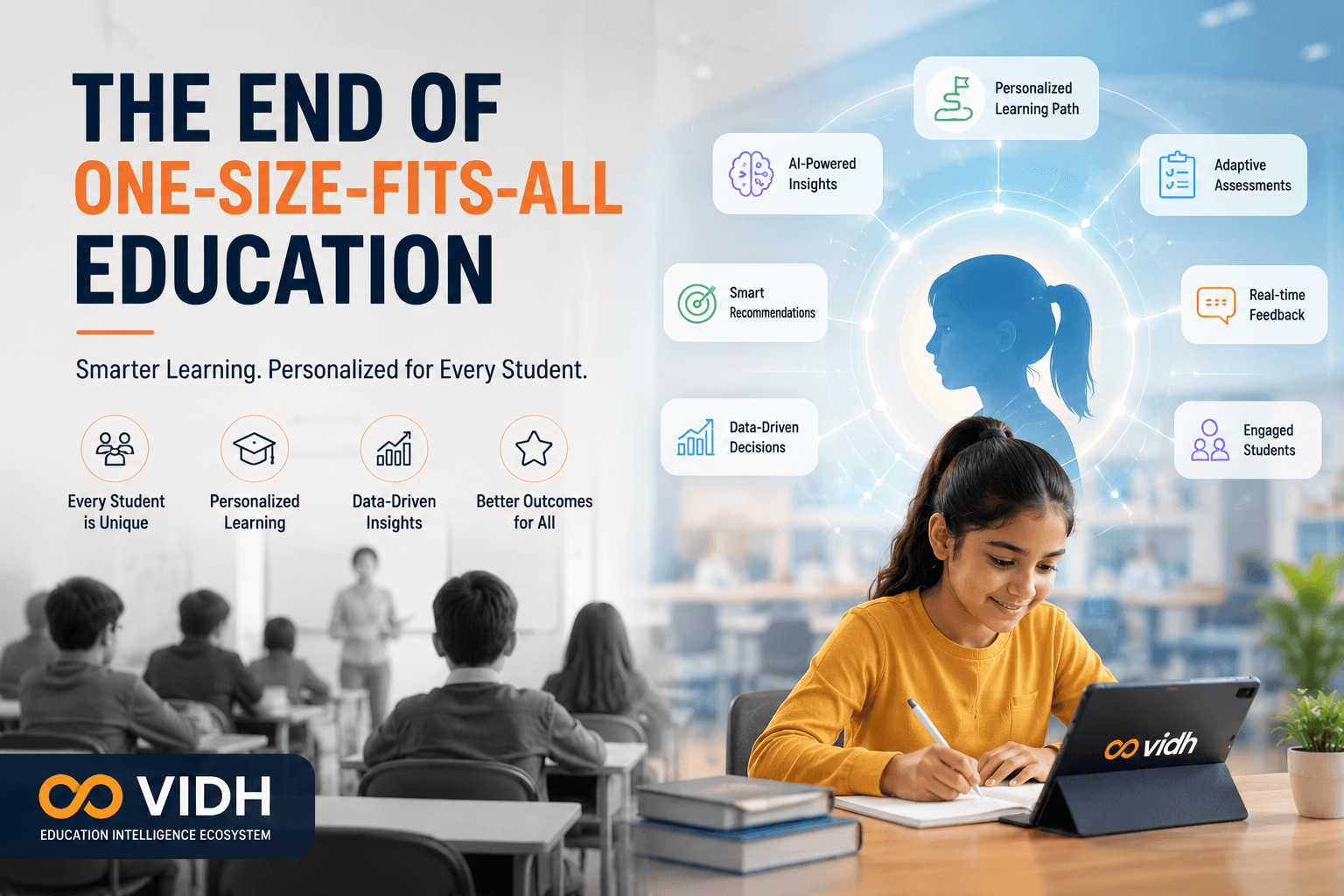
VIDH is an Education Intelligence Ecosystem designed to help schools streamline operations, enhance learning outcomes, improve parent engagement, and make data-driven decisions through connected intelligence and automation.
## Why the Future of Learning Demands Intelligence, Not Standardization
For decades, education has followed a familiar formula.
A single curriculum. A fixed teaching pace. Standardized assessments. Uniform expectations.
The assumption was simple: if every student receives the same education, everyone gets an equal opportunity to succeed.
But reality tells a different story.
Walk into any classroom and you'll find students with different learning styles, strengths, ambitions, challenges, interests, and aspirations. Yet many educational systems continue to deliver the same experience to every learner.
The result?
Some students thrive.
Many struggle.
And countless others never reach their full potential.
Today, as technology transforms every aspect of our lives, one truth is becoming impossible to ignore:
**The era of one-size-fits-all education is coming to an end.**
## The Problem with Standardized Learning
Traditional education models were designed during a time when efficiency was prioritized over personalization.
Schools needed a practical way to educate large numbers of students. Standardized processes helped institutions manage classrooms, measure outcomes, and maintain consistency.
While this approach served its purpose, it also created limitations.
Students learn differently.
Some absorb information visually. Others learn through hands-on experiences. Some excel in mathematics but struggle with language. Others demonstrate extraordinary creativity that traditional assessments fail to recognize.
Yet they are often evaluated through the same framework.
This creates several challenges:
* Learning gaps remain unnoticed.
* High-performing students become disengaged.
* Struggling students fall further behind.
* Talents beyond academics receive limited attention.
* Teachers struggle to provide individualized support at scale.
Education becomes standardized, but not necessarily optimized.
## Every Student Has a Unique Learning Journey
No two students are identical.
Each learner brings a unique combination of:
* Academic strengths
* Learning preferences
* Behavioral patterns
* Emotional needs
* Career aspirations
* Personal interests
The challenge for schools is not recognizing these differences.
The challenge is managing them effectively.
When classrooms contain hundreds or thousands of students, personalization becomes difficult without the right systems and intelligence.
Teachers already carry enormous responsibilities.
Administrators manage complex operations.
Parents expect greater transparency and involvement.
Adding personalized learning without intelligent support can become overwhelming.
This is where educational intelligence changes everything.
## From Data Collection to Learning Intelligence
Most schools today collect enormous amounts of data.
Attendance records.
Exam scores.
Assignment submissions.
Behavioral observations.
Activity participation.
Communication logs.
The problem is not the lack of data.
The problem is that most institutions struggle to transform data into meaningful action.
Information sits in disconnected systems, spreadsheets, reports, and software platforms.
Educators spend time collecting information rather than using it to improve outcomes.
What schools need is not more data.
They need intelligence.
Intelligence that identifies patterns.
Intelligence that detects risks early.
Intelligence that highlights opportunities