Join and be a part of
revolutionary education!
Contact us to get a demo of Vidh.
Download Our Mobile
App For Parents
Available on iOS and Android.


Contact us to get a demo of Vidh.
Available on iOS and Android.
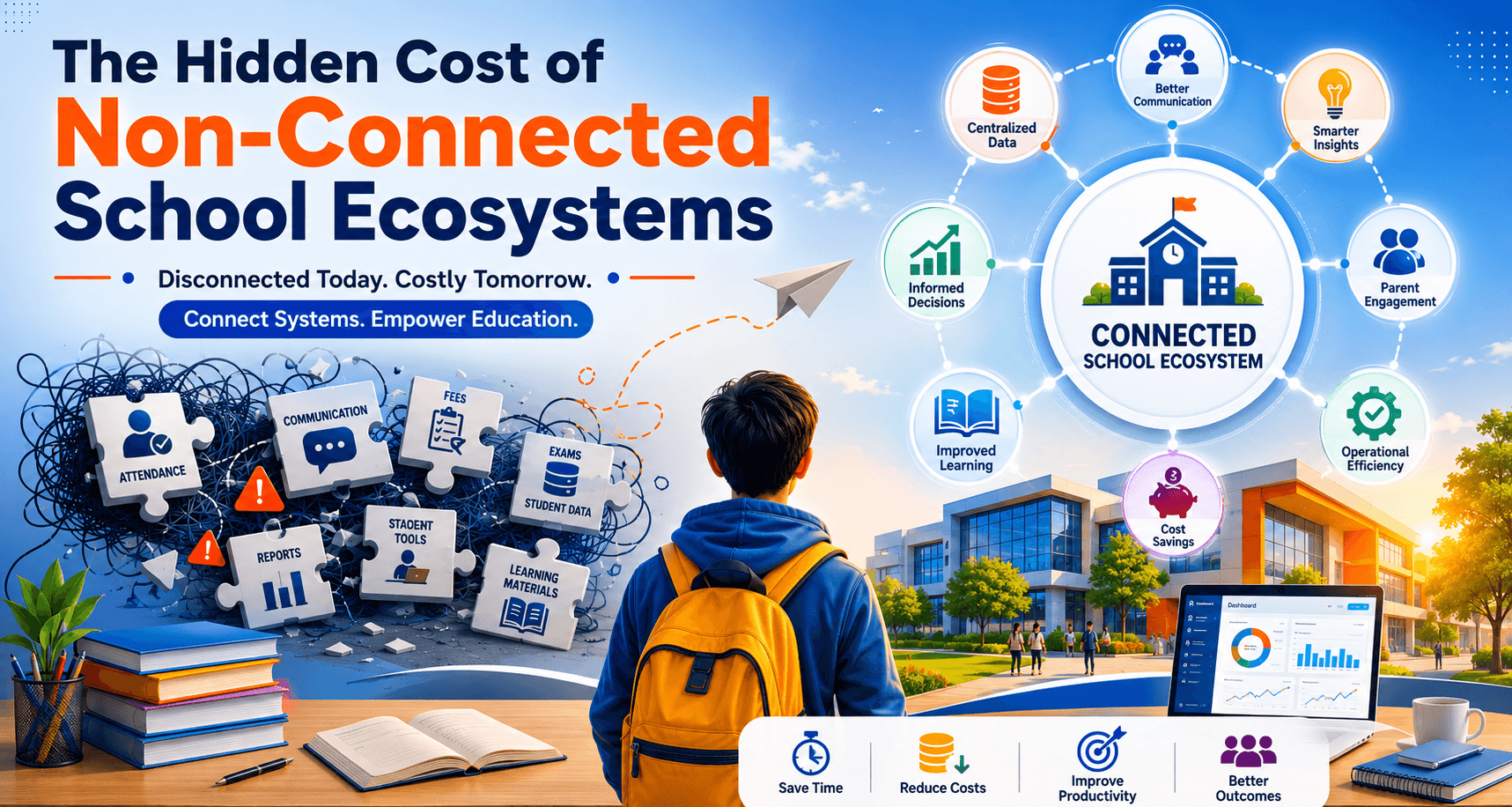
Different departments use different systems. Teachers manage separate platforms. Parents receive fragmented communication. Student data remains scattered across applications. Administrators struggle with disconnected workflows.
THE HIDDEN COST OF NON-CONNECTED SCHOOL ECOSYSTEMS
Schools today use multiple digital tools for academics, communication, administration, assessments, and finance. However, many institutions still operate with disconnected systems that do not communicate with each other.
When attendance, fee management, learning platforms, parent communication, assessments, and student records exist in separate applications, schools face hidden challenges that impact efficiency, learning outcomes, and stakeholder satisfaction.
Administrators spend valuable time managing duplicate data, manual processes, and fragmented reporting. Teachers are burdened with multiple platforms, reducing the time they can dedicate to student engagement and instruction. Students experience inconsistent learning journeys, missed communications, and difficulty accessing resources. Parents often struggle with multiple logins, delayed updates, and limited visibility into their child's progress.
Perhaps the biggest challenge is data fragmentation. Schools generate valuable information every day, but disconnected systems prevent institutions from gaining meaningful insights, identifying learning gaps, personalizing education, and making data-driven decisions.
The financial impact is equally significant. Increased administrative workload, software redundancy, communication failures, staff burnout, lower productivity, and reduced parent satisfaction all contribute to long-term operational costs.
The future of education is not simply digital—it is connected. Schools need integrated ecosystems where learning, communication, administration, analytics, and engagement work together seamlessly.
A connected school ecosystem empowers administrators with better decision-making, helps teachers focus on teaching, keeps parents informed, and creates smoother learning experiences for students.
Because the schools that thrive tomorrow will not be the ones with the most technology—they will be the ones where technology, people, and learning work together as one intelligent ecosystem.