Join and be a part of
revolutionary education!
Contact us to get a demo of Vidh.
Download Our Mobile
App For Parents
Available on iOS and Android.


Contact us to get a demo of Vidh.
Available on iOS and Android.
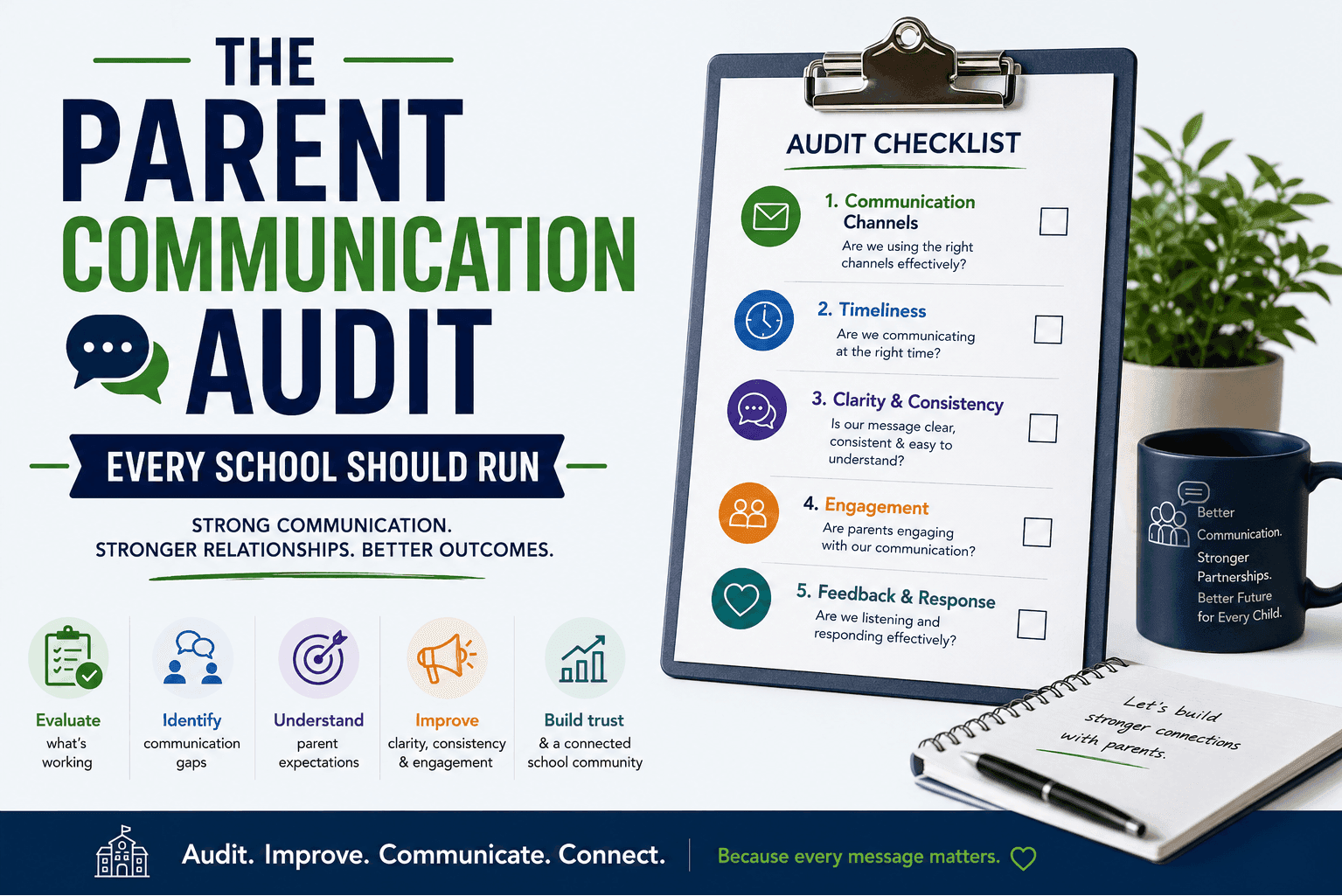
Most schools assume their parent communication is working. The ones that have actually checked are often surprised by what they find.
Here is a question most school leaders have never been asked — and cannot immediately answer:
In the last 30 days, how many parents received a notice from your school, confirmed they received it, and understood what was being asked of them?
Not how many notices were sent. Not how many were posted to WhatsApp. How many reached a parent, registered, and produced the intended response.
For most schools, this number is unknown — and significantly lower than they would guess.
Parent communication is the single most assumed-to-be-working function in school administration. Schools send notices, announcements, homework updates, fee reminders, and event invitations constantly. The assumption, most of the time, is that parents are receiving them, reading them, and acting on them.
A parent communication audit tests that assumption. It examines the gap between what a school sends and what its parent community actually receives, understands, and acts on. In most schools, that gap is larger and more consequential than leadership realises.
This is how to conduct one.
A parent communication audit is not a parent satisfaction survey. Satisfaction surveys tell you how parents feel about the school in general. They rarely isolate communication as a specific variable, and they are subject to halo effects — a parent who loves the school will rate communication highly regardless of its actual quality.
An audit is a structured examination of your communication systems, channels, content, and outcomes against specific criteria. It asks:
The answers to these questions produce an honest picture of where the school's communication is strong, where it is falling short, and — most importantly — what the cost of those shortfalls actually is.
Start with inventory. List every channel through which your school communicates with parents in a typical week. For most schools, the list looks something like this:
WhatsApp class groups (one per section, sometimes more), a school-wide broadcast group, SMS for urgent notices, a school app that was adopted by some parents, occasional emails, physical notices sent home in school bags, and the school notice board that parents read when they happen to be on campus.
Now ask a harder question about each one: do you have evidence that it is working?
WhatsApp groups, used by most Indian schools as the primary parent communication channel, have three structural problems that become more significant as the school grows. First: messages are chronological, which means an important notice about tomorrow's exam can be buried under twelve congratulatory messages and a forwarded health tip by the time a parent checks their phone at 9 PM. Second: there is no delivery confirmation — a school cannot tell whether 80% or 20% of parents saw a specific message. Third: there is no accountability — both directions. The school cannot prove a notice was sent to a specific parent, and the parent cannot prove they never received it.
The channel audit should answer: for each communication channel in use, what is our estimated reach, what is our confirmation mechanism, and what happens to parents who fall through the gap?
Read three recent school notices as if you are a parent who:
For many Indian schools, the honest answer is: partially, or not entirely. School communication is frequently written in formal English that assumes a level of literacy and familiarity with institutional language that a significant portion of the parent community may not have. It is frequently sent during the day, when working parents cannot act on it. It is frequently generic — sent to all parents without acknowledging that different parents need different information.
The accessibility audit asks who is being inadvertently excluded from effective communication by the assumptions embedded in your current approach. The parents who call the office most frequently asking about things that were already communicated are almost always in this group — not parents who missed the notice, but parents for whom the notice didn't land clearly.
Pick a random week from the past term and answer these questions:
This data exists in most schools — in WhatsApp message histories, phone logs, email threads, and the memory of administrative staff. Assembling it for a single week is a useful, if slightly uncomfortable, exercise.
Response time is one of the highest-correlation variables with parent trust. A parent whose question is answered within two hours experiences the school as organised, responsive, and respectful of their time. A parent who follows up twice over three days for the same information experiences the school as slow, inconsistent, and indifferent.
The communication audit should identify: what is our average response time, and is it consistent across different types of parents? In some schools, parents with stronger social connections to the school or administration receive faster responses — not through deliberate favouritism, but through the natural dynamics of informal communication management. Every parent deserves the same response window, regardless of who they know.
For one week, log every communication sent to parents. Then ask three questions about each one:
Was it timely? A notice about Monday's exam, sent Sunday evening, fails the parent who needed to remind their child Saturday night. A fee reminder sent two days before the due date assumes parents check their messages every day. Timing matters.
Was it complete? A notice that says "There will be a school event on Friday" without specifying the time, what the child should wear, whether the parent should attend, or whether normal school hours apply has generated a query before the parent has finished reading it. Every communication that omits something parents need to know will produce a call or message to the office within 24 hours. Count those calls. They tell you what your content is missing.
Was it necessary? Schools that over-communicate — sending notices for events three days away, reminders for fees not yet due, updates about things that haven't changed — train parents to stop reading. Parent communication channels that carry high volumes of low-importance messages will have their high-importance messages ignored. The content audit should identify not just what is missing but what could be removed.
This is the hardest part of the audit — and the most valuable.
Sit with three or four parents, informally, and ask them a single question: is there anything happening at school that you often wish you knew earlier or understood better?
The answers will be consistent and specific. They almost always fall into the same categories:
Their child's day-to-day academic progress — not just at report card time, but ongoing. Whether their child is actually doing the homework they say they're doing. What a specific charge on the fee receipt is actually for. How decisions that affect their child's class are made. What happens when there is a concern about their child and how they will be told.
These are not unreasonable things to want to know. They are the questions parents carry into every parent-teacher meeting, into every conversation with a neighbour who also has a child at the school, and increasingly, into their own assessment of whether the school is the right choice for their family.
The dark matter audit does not require parents to be satisfied with everything. It requires the school to be honest about what it is not currently telling them — and to ask whether the silence is intentional, structural, or simply an oversight that a better system would fix.
A communication audit typically surfaces three categories of findings:
Quick fixes — specific gaps that can be closed within a week. A notice template that is missing a standard piece of information. A WhatsApp group where the school hasn't posted in three weeks. A parent query from ten days ago that was never formally closed.
Structural changes — improvements that require a process or system change. Moving from WhatsApp to a structured communication platform. Creating a standard response time policy. Building a language-accessible version of routine notices.
Cultural shifts — the hardest category, because they require changing habits rather than tools. The default to English when the parent community is primarily Telugu-speaking. The practice of sending notices without checking whether they've been received. The assumption that no news from parents means satisfied parents.
Address the quick fixes immediately. They demonstrate that the audit produced action, not just a report. Plan the structural changes with a realistic timeline. And treat the cultural shifts as ongoing work — not a project with a completion date, but a standard the school is continuously working toward.
Most schools that conduct a parent communication audit for the first time discover the same thing.
Not that their communication is bad. Most schools are communicating constantly, with genuine effort and good intentions.
What they discover is the gap between effort and outcome — the considerable energy going into communication that is not reliably reaching parents, is not consistently understood, and is not producing the response the school intended.
That gap does not close by communicating more. It closes by communicating more intentionally — with a clear channel, confirmed delivery, accessible language, and a system for knowing when something has not landed and following up accordingly.
The audit does not fix the communication. It identifies what fixing it would require.
That is where the real work begins.