Join and be a part of
revolutionary education!
Contact us to get a demo of Vidh.
Download Our Mobile
App For Parents
Available on iOS and Android.


Contact us to get a demo of Vidh.
Available on iOS and Android.
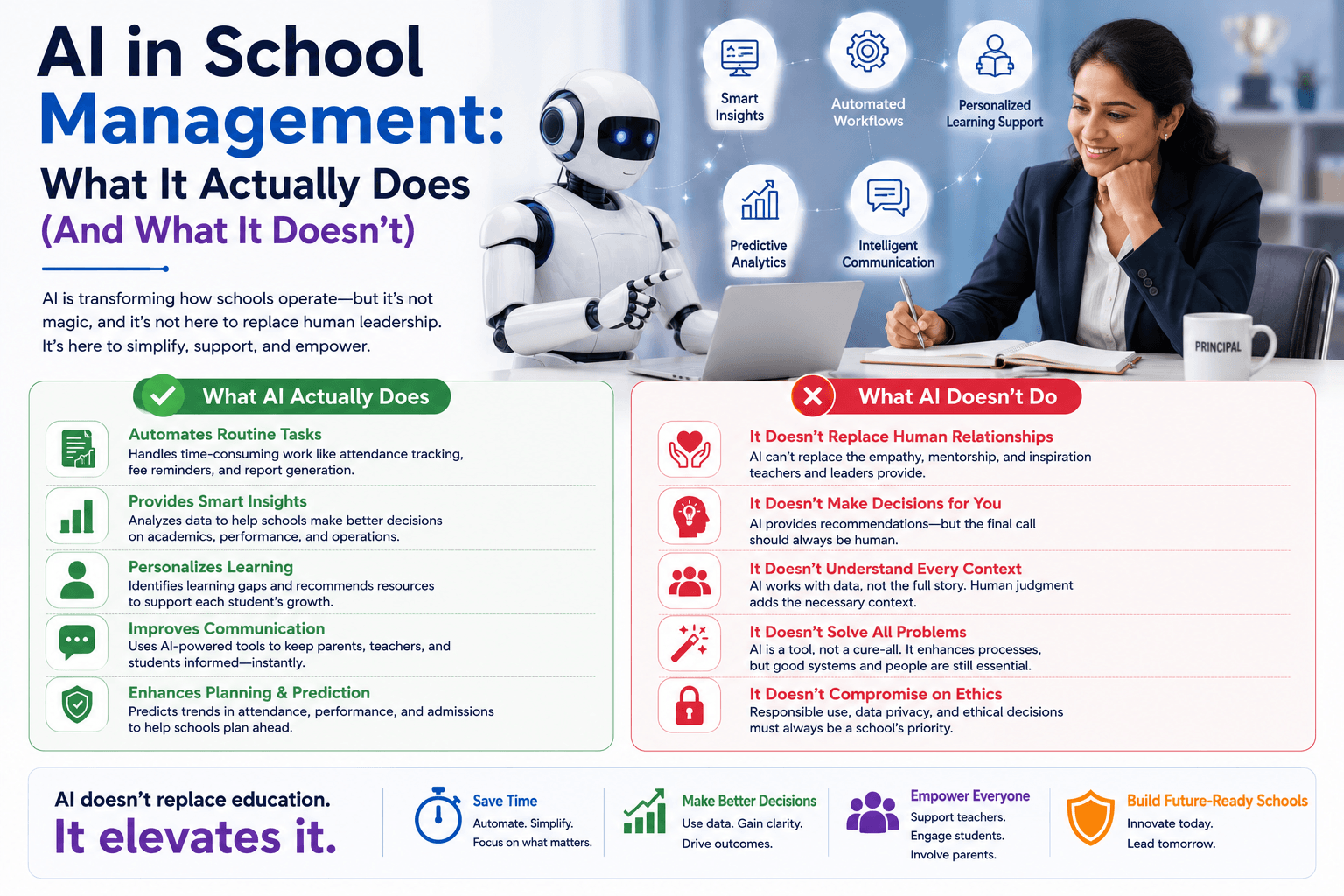
"AI for schools" is everywhere as a phrase. But what does it actually mean when applied to day-to-day school operations? A practical breakdown.
The phrase "AI-powered" has become so common in EdTech marketing that it has lost much of its meaning. Every software product, from attendance apps to parent communication tools, now claims some form of artificial intelligence. For school administrators making purchase decisions, this noise is genuinely unhelpful.
So let us be specific. When a school management platform says it uses AI, what is it actually doing? And what should school leaders look for - and look past?
What AI in School Management Actually Looks Like
At the most practical level, AI in school administration shows up in three categories:
1. Content Generation for Teachers
The most immediately useful AI application in school management is lesson plan and worksheet generation. A teacher can specify the topic, the class, the curriculum board, and the difficulty level — and receive a structured lesson plan in seconds. This is not replacing the teacher; it is eliminating the blank-page problem that consumes hours of prep time weekly.
The same capability extends to exam paper drafting, worksheet generation, and even generating differentiated materials for students at different ability levels within the same class. For Indian schools specifically, platforms pre-trained on CBSE and State Board curriculum standards can generate materials that are directly aligned with what students are being assessed on.
2. Student Performance Analytics
AI can surface patterns in student data that would take a teacher days to identify manually. Which students are consistently underperforming in one specific area? Who has been absent enough to affect their learning continuity? Which students' scores have declined over consecutive assessments?
These are not hard analyses in principle — they are just tedious at scale. AI makes them instant and actionable, showing up as a "student persona" or performance profile that gives teachers and parents a consolidated view of where a student stands and what they need.
3. Administrative Automation
Fee reminders, attendance flags, subscription control when fees are unpaid - these are rule-based automations that schools sometimes incorrectly label as AI. They are valuable, but the distinction matters: these are automated workflows, not intelligence. Genuine AI sits on top of these automations and helps administrators make decisions, not just execute them.
What AI in School Management Does Not Do
AI does not replace curriculum judgment. It can generate a lesson plan template, but an experienced teacher knows when a suggested sequence does not work for their specific class. AI is a productivity tool, not a pedagogical authority.
AI also does not solve data quality problems. If a school's student records are incomplete, inconsistent, or siloed across three different systems, AI will produce outputs that reflect that mess. Garbage in, garbage out - the model cannot compensate for missing or inaccurate inputs.
Finally, AI does not automatically mean data privacy. Schools should ask directly: where is this data being processed? Is student data being used to train external models? What are the data retention policies? A Google-certified platform, for instance, operates under Google's compliance framework - a meaningful credential that answers many of these questions before they need to be asked.
What to Ask Before Buying an "AI-Powered" School Platform
Before accepting any AI claim at face value, school leaders should ask:
1. What curriculum standards is the AI trained on? (CBSE, State Board, ICSE, Cambridge — they are not interchangeable.)
2. Does the AI support regional language generation, or only English?
3. Who owns the data that the AI processes?
4. Can teachers override or edit AI-generated content without restrictions?
5. What happens to AI outputs if the platform subscription ends?
These questions do not make AI a bad idea. They make the purchase decision an informed one.
The Bottom Line
AI in school management, done properly, is a time multiplier. It does not transform schools - it frees the people inside schools to focus on what technology cannot do: build relationships, exercise judgment, and teach.
The schools that will benefit most from AI are not the ones with the most ambitious expectations. They are the ones with the clearest understanding of what the technology actually is.
Vidh's "With Intelligence" module is pre-trained on CBSE and State Board standards, supports native Indian languages including Telugu and Hindi, and generates lesson plans, exams, and worksheets — with teacher control at every step.