Join and be a part of
revolutionary education!
Contact us to get a demo of Vidh.
Download Our Mobile
App For Parents
Available on iOS and Android.


Contact us to get a demo of Vidh.
Available on iOS and Android.
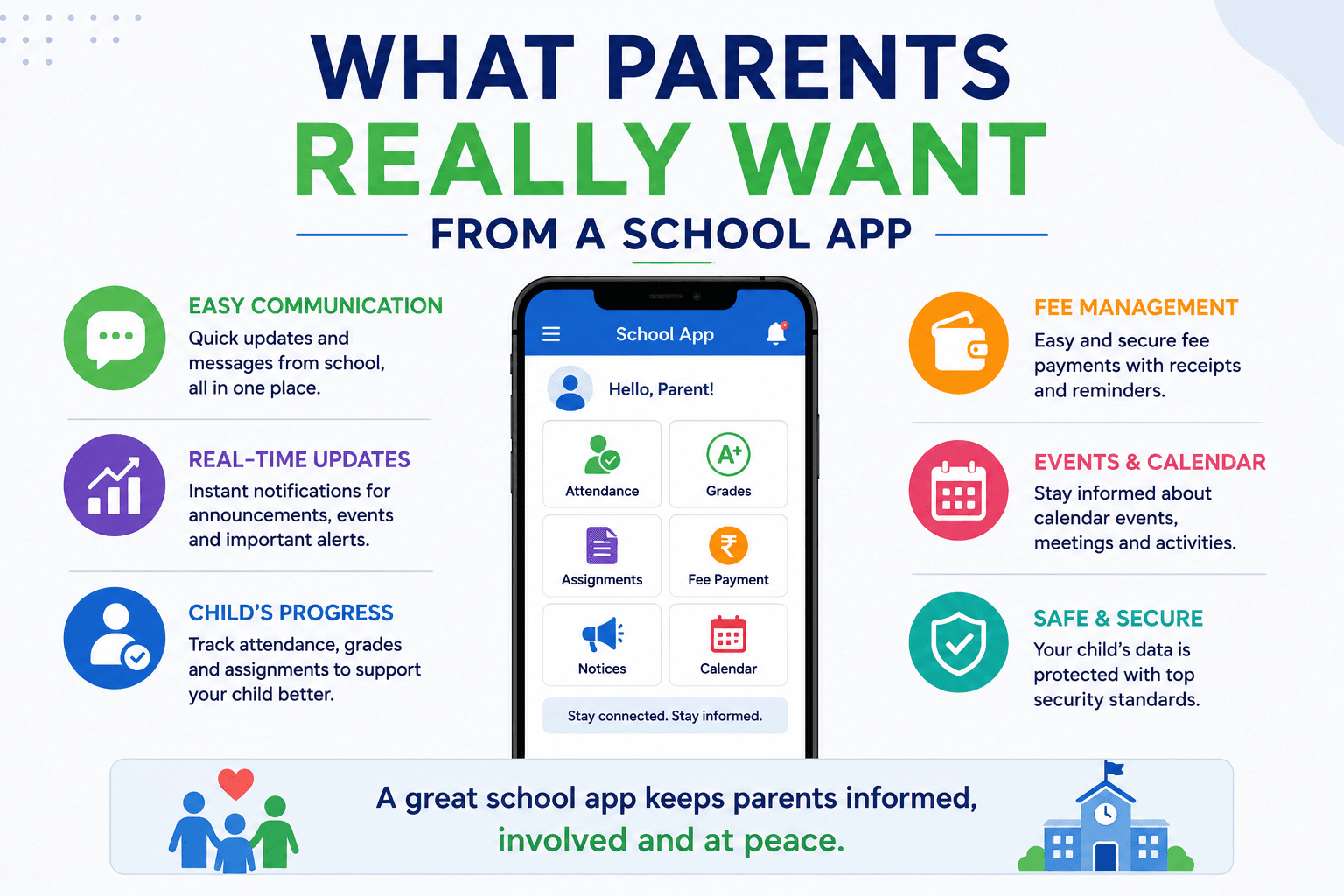
Parent apps in education have come a long way - but many schools still build the wrong things. Here's what parents actually want, based on how they use these tools.
When schools deploy a parent-facing app, they almost always build it around what administration finds convenient to communicate - announcements, event photos, circulars. Parents tend to want something different.
Understanding that gap is the difference between an app that parents check twice and then forget, and one that becomes a daily touchpoint between the school and the families it serves.
What Parents Actually Open an App For
Data from parent engagement platforms consistently shows that the most-used features are not the ones schools expect. Parents are not primarily using these apps to read newsletters. They are using them to answer three fundamental questions:
1. Is my child safe and present?
Attendance is the highest-frequency, highest-urgency information a parent wants. A parent who knows their child attended all classes that day has a baseline of confidence. A parent who discovers at 4 PM that their child was marked absent at 10 AM - but was not notified - has a trust problem with the school.
Real-time attendance visibility, with appropriate notification, is not a premium feature. It is the floor of what a parent app should do.
2. How is my child performing?
Parents want to understand their child's academic trajectory - not just a report card twice a year, but ongoing visibility into how their child is doing. Assignment completion, assessment scores, areas of strength and weakness, and historical progress over time.
When parents can see this data between parent-teacher meetings, those meetings become more productive. Both sides arrive prepared. The conversation is specific rather than general. Teachers spend less time reciting data and more time discussing what to do about it.
3. What does my child need to do?
Homework and class notes are the operational backbone of the parent-child relationship at home. A parent who knows what their child's homework assignment is - and can see the attached materials - can provide meaningful support. A parent who only knows there was "some homework" cannot.
The distinction matters: parents should see the assignment and any attached documents, while teachers retain exclusive access to answer keys and assessment materials. This boundary is what makes the system trustworthy for both sides.
What Parents Want to Control
Beyond visibility, parents increasingly want a degree of control over their own experience within the app. This includes:
1. The ability to send queries directly to the school - not through a general email that goes to a mailbox nobody monitors, but a structured inquiry system that reaches the right person
2. The ability to view their payment history and upcoming fee dues without calling the office
3. Control over notification preferences - which updates trigger an alert and which do not
Critically, parents also want to know that their data is being handled responsibly. A parent should never wonder why their child's information is appearing somewhere unexpected. Schools that communicate clearly about what data the app collects - and why - build trust faster than schools that say nothing and hope nobody asks.
What Schools Need to Control
A parent app is not a one-way broadcast channel, but it is also not a free-for-all. Schools need meaningful administrative control over what parents can see and when.
A school should be able to toggle the visibility of financial information, transaction histories, and social media event photos based on its own policies and the needs of its parent community. If a student's enrollment status changes - a mid-year withdrawal, or non-payment of fees - the school should be able to restrict app access accordingly without the parent requiring manual notification of every step.
This is not about withholding information. It is about the school maintaining appropriate administrative control over its own communications.
The App That Parents Recommend
The parent apps that generate word-of-mouth recommendations share a common characteristic: they save parents time on things that currently waste it. Calling the school office to check attendance. Waiting for the school diary to find out what homework was assigned. Going to the school in person to enquire about fee payment.
When an app eliminates even two or three of these friction points, parents notice. They recommend the school to other parents. They cite the app as evidence that the school is well-organized and genuinely invested in communication.
That reputational benefit - difficult to quantify but very real - is one of the underappreciated returns on investment in parent engagement technology.
Vidh's parent app includes real-time attendance visibility, academic performance summaries, homework and notes access, direct parent-to-school inquiry, fee history, and administrative controls for school-side visibility management.