Join and be a part of
revolutionary education!
Contact us to get a demo of Vidh.
Download Our Mobile
App For Parents
Available on iOS and Android.


Contact us to get a demo of Vidh.
Available on iOS and Android.
The future isn't what it used to be. We used to educate children for a world of relative stability—teach them the established facts, ensure they memorize the rules, and they would be set for a linear career path.
To understand why exposure to options is crucial, let’s look at how memory and thought processing work using a simple analogy.
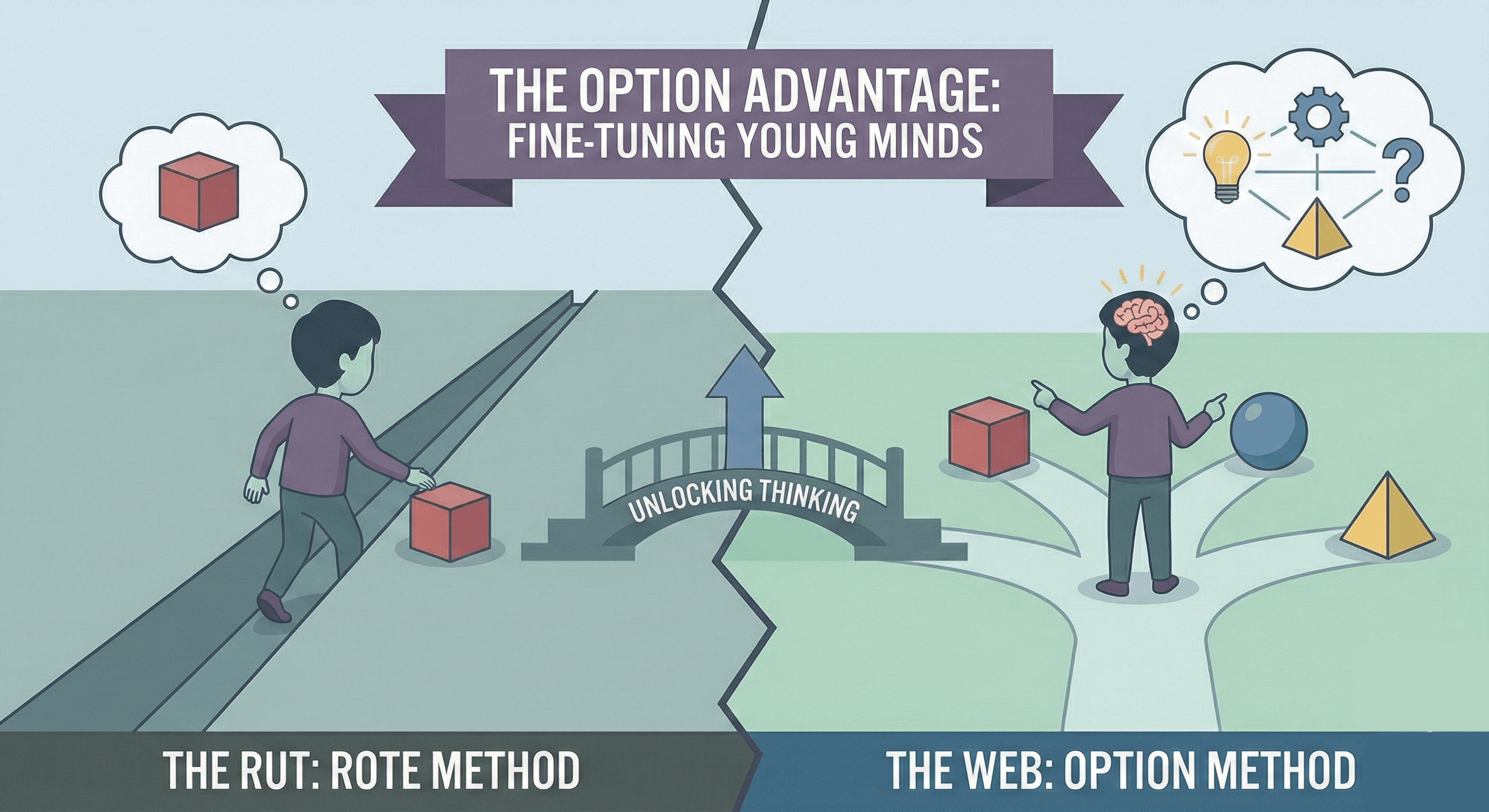
Imagine a child’s mind like a grassy field. Every time they have a thought or learn a fact, a path is trodden in the grass.
Scenario A: The Rote Method (The Rut) If you show a child the same red block over and over again, saying "This is a block," you are walking the exact same path across that field every single day. The path becomes a deep, efficient rut. The child will instantly recognize that specific red block. But that is all they know. Their thinking is confined to that single rut. If you show them a blue sphere, their brain has no existing pathway to process it relative to the block.
Scenario B: The Option Method (The Web) Now, imagine you show the child the red block, but you place it next to a blue sphere and a yellow pyramid. You ask, "How are these different? Which one rolls? Which ones stack?"
Suddenly, you aren't just treading one path. You are creating a complex web of crisscrossing trails in the grassy field. You are forcing their brain to compare, contrast, categorize, and evaluate.
By presenting options and comparisons, you increase what cognitive scientists might call the "likelihood of thoughts." You are creating more potential neural connections. When a new challenge arises later in life, the child raised in Scenario A has only one rigid tool. The child raised in Scenario B has a versatile toolkit and a brain wired to look for connections.
Unlocking the Essential Soft Skills
When we shift from mere repetition to comparative exposure, we aren't just teaching facts better; we are cultivating the essential "soft skills" required for the future. These are the human capabilities that algorithms cannot easily replace.
Here are the key soft skills developed when we force the brain to weigh options:
1. Critical Thinking and Nuance
Critical thinking is impossible in a vacuum. You cannot evaluate the worth of an idea if it’s the only idea you’ve ever encountered. By exposing children to contrasting viewpoints, different methods of solving a math problem, or varied cultural perspectives, we teach them to analyze the space between the options. They learn that few things are black and white, developing the nuance needed for complex problem-solving.
2. Cognitive Flexibility (Adaptability)
In a "drastic future," the ability to pivot is paramount. If a child’s mind is fine-tuned only on singular, repeated tracks, sudden change induces panic. A mind used to navigating options, however, is resilient. When one path is blocked, their brain is already wired to ask, "What are the alternatives?" This cognitive flexibility is the cornerstone of adaptability.
3. Complex Decision-Making
Life is rarely about choosing between a definitely right answer and a definitely wrong one; it’s usually about choosing between three decent options with different trade-offs. By constantly presenting children with choices—even small ones—and asking them to articulate why they chose X over Y, we are putting their decision-making muscles through necessary resistance training.
4. Pattern Recognition and Creativity
Creativity is often described as the ability to connect seemingly unrelated ideas. When we use the comparative model (like the block vs. the sphere), we are training the brain to look for underlying patterns—texture, shape, function—rather than just surface-level identity. This ability to see the "connective tissue" between disparate options is the fuel for innovation.
Fine-Tuning Minds for the Drastic Future
How do we practically fine-tune a child's mind for this reality? We must become facilitators of exploration rather than just dispensers of facts.
To prepare our children for the future, we must be brave enough to let them be confused temporarily. The struggle to choose between options, to compare contrasting ideas, and to forge new mental pathways is the very process of "unlocking thinking."